Executive Resume: Examples and Tips (2026)

How to write an executive resume for VP, C-suite and board roles: scope and P&L near the top, board service, a two-page example and a free template.

Template:

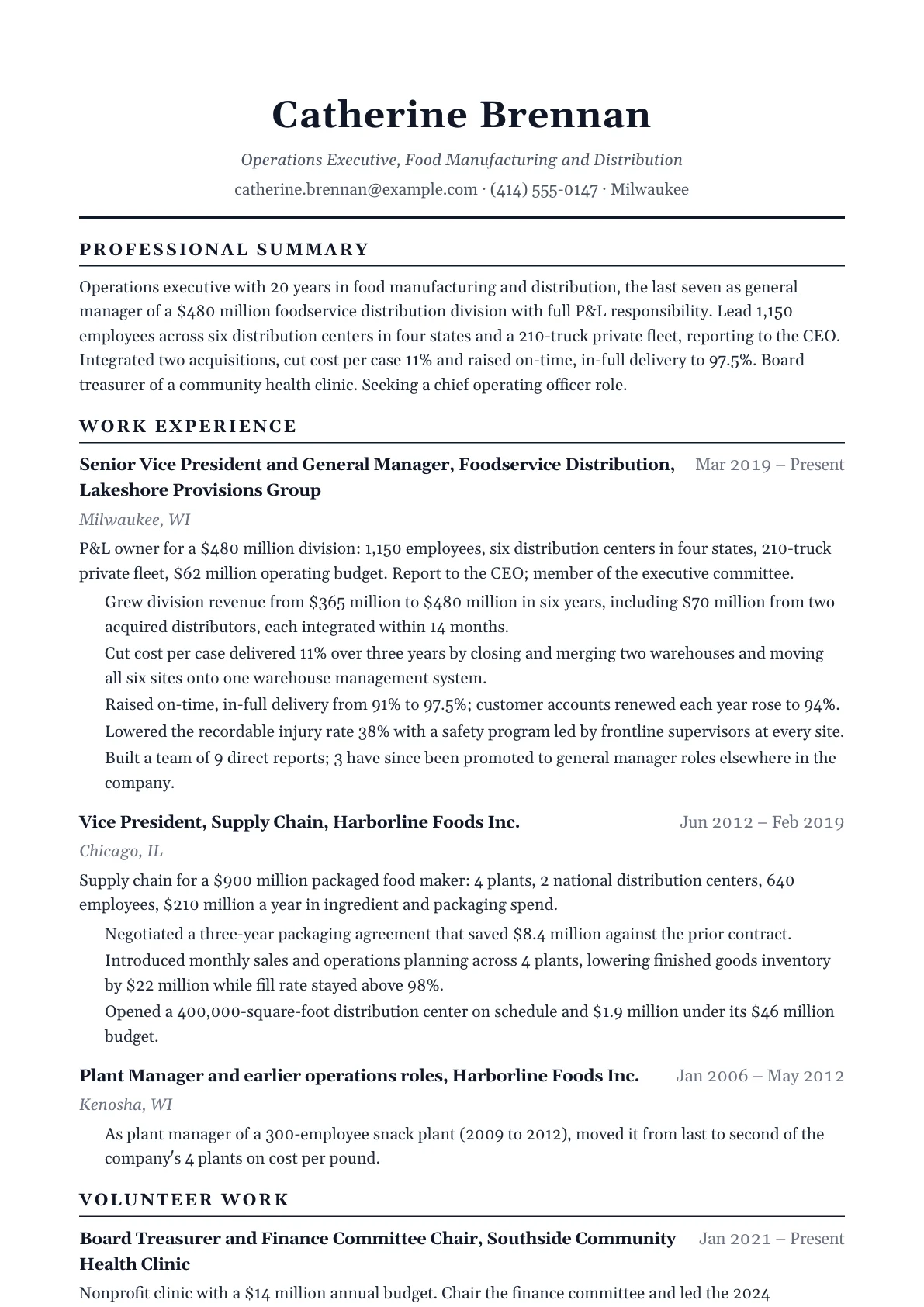
A division general manager in food distribution applying for a chief operating officer role at a food manufacturer.

Why this resume works

  • Scope is stated in plain words under each title before any bullet: a $480 million P&L, 1,150 employees, six distribution centers and a 210-truck fleet, so a search committee can size the job at a glance.
  • Each bullet is a business result with a time frame: revenue from $365 million to $480 million, cost per case down 11% in three years, on-time delivery from 91% to 97.5%.
  • The clinic board seat shows governance, the part of a chief operating officer's job that sits outside operations: she chairs a finance committee for a $14 million budget and led a refinancing.
Edit & download this resume

Edit it in the free builder, then download the PDF with no watermark. A free account is only needed to download.

An executive resume answers a different question from every other resume. The people reading it (a chief executive, a board search committee, or a recruiter the company has hired to fill the seat) already assume you can manage. What they need to know is the size of what you have run and what changed because you ran it: the revenue or budget you answered for, how many people rolled up to you, how many sites or markets, who you reported to, and the few decisions that moved the business. When those facts are buried in the sixth bullet of your second job, the reader has to dig for them, and most will not.

This guide covers how to put scope in plain text at the top, how to write results at the level a board cares about, where board and advisory seats go, how far back to go, and why two pages is normal at this level. The complete example is a division general manager applying to become chief operating officer of a food company. If you run a site or a function below the executive level, the operations manager resume example is the better fit, and if you are between roles after a sale or a restructuring, read the employment gap guide too.

How to write an executive resume

1

Use a headline that states your level and your field

Under your name, one line such as Operations Executive, Food Manufacturing and Distribution. It tells the reader where you sit and which industry you know. Keep the exact title you want (chief operating officer, vice president of sales) for the last line of the summary, so the same resume can go to a few different searches with one small edit.

2

Put the size of your job in the first three lines

Your summary should give the numbers a board uses to compare candidates: revenue or P&L you own, operating or capital budget, total headcount, number of sites, states or countries, and who you report to. Write them as plain text, not in a graphic or a sidebar, so they survive being pasted into a recruiter's system or a candidate report. Add two or three results that define your tenure, then the role you want.

3

Open every role with a one-line scope statement

Before the bullets, write one sentence that describes the job itself: the size of the unit, the people and budget in it, and the reporting line. P&L owner for a $480 million division, 1,150 employees, six distribution centers, reporting to the CEO does more work than any bullet below it. If you did not hold a full P&L, say exactly what you did hold: a cost center, a capital budget, a revenue target.

4

Write results the way a board would describe them

Each bullet names a decision you made and what it did to revenue, cost, margin, risk, customers or people, with a time frame. Say what was yours and what was the team's. If your company is private or the numbers are confidential, use percentages, rounded figures or plain descriptions (a top-five national customer) rather than figures you are not allowed to share.

5

Show board, advisory and governance experience

Nonprofit boards, advisory boards, industry association boards and committee roles (audit, finance, compensation) all belong on the page. For each, give the organization, what it is and how big, your seat and your committee, and one thing you did in the role. Many executive searches ask about governance, and these lines answer the question before it comes up.

6

Condense the early years and stop at two pages

Give full detail to roughly the last 15 years. Earlier jobs can collapse into one entry, such as Plant Manager and earlier operations roles, with a single line that shows the trajectory. Graduation years are optional at this level. Leave off references, hobbies and personal details, and keep a separate one-page biography ready for board searches and conference introductions.

How long should an executive resume be, and in what order?

Two pages is normal for a senior leader. One page usually forces you to cut the scope lines that make an executive resume useful, and three pages tells the reader you could not decide what matters. A long career fits on two pages when the recent roles get detail and the early ones get a line.

The order that works for most executives:

  • Name, headline and contact details, with a LinkedIn address if your profile is current. Dates and titles there should match the resume exactly, because recruiters check both.
  • Summary of three to five sentences with the scope numbers.
  • Experience, newest first, each role opening with its scope statement.
  • Board and advisory roles. In CVPoet these go in the Volunteer section when they are unpaid seats. A paid corporate board seat can sit under Experience instead.
  • Education, then any executive programs that relate to the role.
  • Skills last, as a short list of areas you are known for.

Some executives add a short Career highlights list of three results under the summary. It helps when your best results are spread across several companies; if they all come from your current job, the summary and first role already do that work.

Keep the design conservative. A single column, one typeface and no photo, logo or color blocks reads as confident, and it survives the forwarding and printing an executive resume goes through. The Classic template is built for exactly this.

The example, line by line

The example is for Catherine, who runs a food distribution division and is applying to be chief operating officer of a larger food manufacturer. Here is what each part is doing.

Headline: Operations Executive, Food Manufacturing and Distribution. Level and industry, nothing else. The target role appears at the end of the summary instead.

Summary: the first sentence gives 20 years and a $480 million P&L. The second gives the size of the organization: 1,150 employees, six distribution centers, four states, a 210-truck fleet, reporting to the CEO. The third names three results. A search committee could stop reading here and still place her.

Current role: the scope line repeats the numbers in one place and adds the $62 million operating budget and her seat on the executive committee. The bullets cover growth (revenue from $365 million to $480 million, with $70 million from two acquisitions integrated within 14 months each), cost (11% lower cost per case), customers (97.5% on-time, 94% of accounts renewed), safety (38% fewer recordable injuries) and people (3 of her 9 direct reports promoted). Five themes, one bullet each.

Previous role: vice president of supply chain at a $900 million manufacturer, which is the half of the chief operating officer job her current role does not cover. Three bullets: $8.4 million saved on packaging, $22 million less inventory at a 98% fill rate, and a distribution center opened $1.9 million under a $46 million budget.

Earlier roles: one entry and one line for 2006 to 2012, which keeps the page count at two while showing she ran a 300-employee plant.

Board and advisory roles: the clinic seat names the budget ($14 million), the committee she chairs and a concrete piece of work (the 2024 refinancing). The university advisory board adds 6 interns a year, a small detail that shows she develops people outside her own company.

Education and skills: degrees without years, and eight skills a board would recognize, from P&L management to board and investor reporting.

Mistakes that weaken an executive resume

  • Duties with no size. Responsible for operations and logistics could describe a 20-person warehouse or a national network. Give the revenue, budget, headcount and sites every time.
  • A summary made of adjectives. Visionary, strategic, transformational leader is what every candidate in the search writes. Replace each adjective with a number or a result that proves it.
  • Claiming the whole company's results. If revenue grew because the market grew, say what your part was. At this level references are checked closely, and an inflated claim can end a search.
  • Sharing numbers you are not allowed to share. Private company financials, customer names and deals still under confidentiality should become percentages or descriptions. Careful handling of confidential information is itself part of what the reader is judging.
  • Every job since the first one. A detailed entry for a job from 25 years ago pushes the resume to three or four pages and dates you without adding anything. Condense it.
  • A designed layout. Two columns, icons, skill bars and a headshot look dated at this level and often break when the file is forwarded or pasted into a search firm's system.

These guides cover situations and roles close to this one:

Every example is in the resume examples hub, grouped by job and situation.

Build it free, no watermark

CVPoet's resume builder is free to use without an account. Start from this example or a blank page, pick one of four ATS-friendly designs, and download a PDF with no watermark on any plan.

Frequently asked questions

How long should an executive resume be?

Two pages for most senior leaders. Give the last 15 or so years full detail and condense the rest into a line or two. Go past two pages only if a posting or a search firm asks for a full career history.

What should an executive resume include?

A headline with your level and field, a summary with your scope (P&L or budget, headcount, sites, reporting line), each role with a one-line scope statement and three to five results, board and advisory roles, education and a short skills list.

How do I show P&L responsibility if I never owned a full P&L?

Say exactly what you did own: an operating budget, a cost center, a capital budget, a revenue target or a margin goal. <em>Managed a $40 million operating budget</em> is accurate and strong. Calling it a P&L when it was not will come apart in the first interview.

Where do board positions go on a resume?

In their own section after experience, titled for board and advisory roles or placed in the volunteer section for unpaid nonprofit seats. Give the organization, its size, your seat and committee, and one thing you did.

Should an executive resume have a career highlights section?

Only when your best results come from different companies. Three short bullets under the summary can pull them together. If your best work is all in your current job, the summary and first role already cover it.

Should I include graduation dates?

It is optional. Many senior candidates leave the years off degrees earned more than 15 or 20 years ago. The degree and the school are what the reader needs.

Do I need an executive summary or an objective?

A summary, not an objective. State your level, your scope and your defining results, then name the role you want in the last line. An objective that only says what you want gives the reader nothing to judge.

How is an executive resume different from a board biography?

A resume lists roles with results for a specific job search. A board biography is one page of prose in the third person, used when you are nominated to a board or introduced at an event. Keep both, and keep the facts identical.

Should I put a photo on an executive resume?

No, not for jobs in the United States. Your LinkedIn profile can carry a photo; the resume should not.

Can I list results that are confidential?

List the result without the confidential part. Use a percentage instead of a dollar figure, a description instead of a customer name, and leave out any deal that has not been announced.

Build your executive resume

Start from Catherine's two-page example in the Classic template. Free to build, and the PDF has no watermark.

Build your resume, free
Executive resume example
Executive resume example The example above as an image, to save or share. To change it, use Edit & download this resume at the top of the page. Open the full-size image