Military to Civilian Resume: Examples (2026)

How to turn military experience into a civilian resume: translating rank, job codes and duties, listing a clearance, a full example and a free template.

Template:

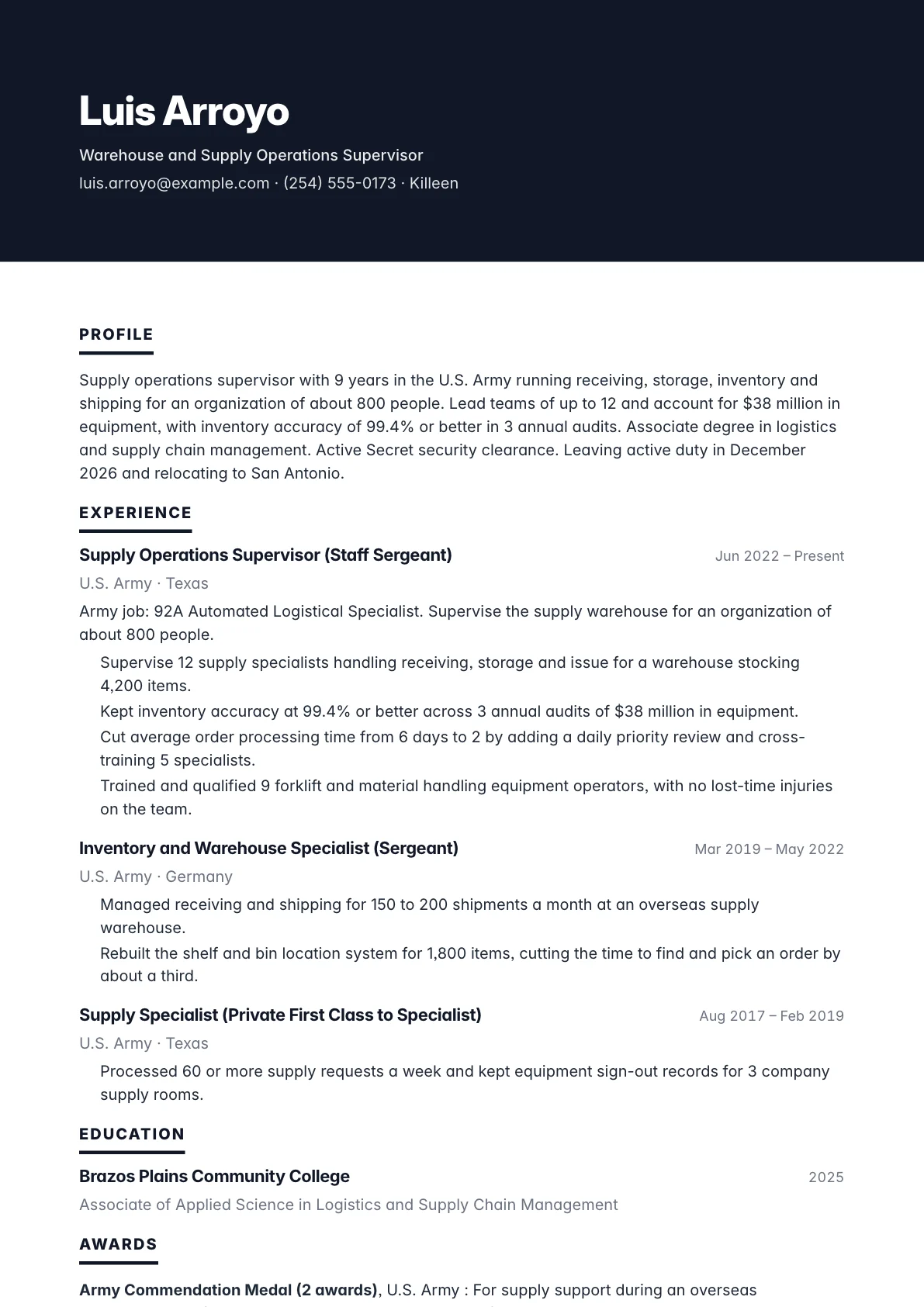
An Army staff sergeant (92A Automated Logistical Specialist) leaving active duty and applying for a warehouse operations supervisor job at a distribution center.

Why this resume works

  • Each Army role leads with a civilian title (Supply Operations Supervisor) and puts the rank in parentheses, so a warehouse hiring manager sees a supervisor first and a rank second.
  • Military scale is turned into business terms: 12 people supervised, 4,200 stocked items, $38 million in equipment, order processing cut from 6 days to 2.
  • The Secret clearance and the December 2026 separation date sit in the summary, answering two practical questions a recruiter will have about any service member in transition.
Edit & download this resume

Edit it in the free builder, then download the PDF with no watermark. A free account is only needed to download.

Military experience is some of the strongest experience a resume can hold, and some of the hardest for a civilian to read. A hiring manager at a distribution center does not know what a 92A does, how many people a staff sergeant supervises, or what a property book is. If the resume makes them guess, they usually guess low. Your job on a military to civilian resume is translation: the same facts, in the words the civilian reader already uses.

This guide covers choosing a civilian target, turning ranks and job codes (MOS, AFSC, rating) into job titles, translating duties and scale, listing a security clearance, using official tools and programs, and a complete example for an Army supply sergeant moving into warehouse operations. If you are aiming for a federal job instead, read the federal resume guide as well, because USAJOBS has its own required details.

How to write a military to civilian resume

1

Choose a civilian target job first

You cannot translate for a reader you have not picked. My Next Move for Veterans, sponsored by the U.S. Department of Labor, lets you enter your branch and your job code or title and suggests civilian careers with similar work. The O*NET military crosswalk does the same search in more detail. Pick one civilian job title, then read five real postings for it and note the words they repeat.

2

Turn ranks and job codes into job titles

Write a civilian title that describes the work, then the rank in parentheses: Supply Operations Supervisor (Staff Sergeant). Give your MOS, AFSC or rating once, in plain words, under the title. Civilian readers judge the work, not the rank; even OPM's federal qualification policies say military ranks are not used to evaluate specialized experience, and the work actually performed is.

3

Translate duties and scale into business terms

Soldiers, sailors and airmen become team members or employees. A battalion or squadron becomes an organization of a stated size. A mission becomes an operation or a project. Then add the numbers civilians use: people supervised, dollar value of equipment or budget, items in inventory, orders a week, accuracy rates, time saved.

4

Replace acronyms and awards with plain words

Every acronym either goes or gets spelled out and explained. Keep only one or two awards that show performance, and add a short note on what they were for. The civilian reader cannot rank a Commendation Medal, but they understand awarded for an inspection with no deficiencies.

5

Add your clearance, training and education

If you hold a security clearance and the job could use it, give the level and status (Active Secret security clearance) and update the status after you separate. OPM's resume guidance lists a current security clearance as a detail worth including when relevant. List civilian degrees, credentials and job-related training by their full names.

6

Show when you can start, and use SkillBridge if you can

Put your separation month and the city you are moving to in the summary. If you are still serving, ask your transition office about SkillBridge, which lets service members gain civilian work experience through training, apprenticeships or internships during the last 180 days of service, with approval from their unit commander. A SkillBridge placement goes on your resume as its own job entry.

A translation list for common military terms

Use these as a starting point, and check every one against the words in your target postings:

  • NCO in charge, section chief: supervisor, team lead or operations supervisor.
  • Platoon leader, company commander: manager of a team or department of a stated size.
  • Soldiers, sailors, airmen, Marines: team members, employees or staff.
  • Battalion, squadron, command: organization or division, with the number of people.
  • Mission: operation, project or assignment.
  • Property book, hand receipt: equipment inventory, asset records, sign-out records.
  • Counseling, evaluations: performance reviews and coaching.
  • Deployment: overseas assignment, or a temporary assignment to another site.

Keep the order simple: summary, experience with each military role as its own entry, education and training, then skills. One page works for a first enlistment; two pages is reasonable for senior noncommissioned officers and officers with ten or more years. A bold, single-column template like the one in the example helps the civilian titles stand out, and every CVPoet template uses the same layout underneath, so you can switch without retyping.

The example, line by line

The example is for Luis, a staff sergeant with 9 years in the Army, applying to supervise a warehouse at a distribution center in San Antonio.

Headline: Warehouse and Supply Operations Supervisor. The job he is applying for, in the posting's language, with no military term in it.

Summary: the work (receiving, storage, inventory, shipping), the scale (about 800 people supported, teams of up to 12, $38 million in equipment), a result (99.4% accuracy in 3 audits), then the degree, the Secret clearance, and when and where he can start.

Current role: Supply Operations Supervisor (Staff Sergeant), with 92A Automated Logistical Specialist named once in the line under it. The bullets read like any warehouse supervisor's: 12 people, 4,200 items, audits passed, order time from 6 days to 2, and 9 equipment operators trained.

Earlier roles: the overseas assignment becomes an overseas supply warehouse with 150 to 200 shipments a month and 1,800 items reorganized. His first role gets one line with 60 or more requests a week.

Education and award: the associate degree finished in 2025 while serving, and one award entry covering 2 Army Commendation Medals with a plain note on what each was for.

Skills: civilian warehouse skills first. GCSS-Army stays, with a short explanation in parentheses, for readers at defense contractors who know it.

Mistakes that keep veteran resumes from being understood

  • Pasting from evaluation reports. Evaluation bullets are written for promotion boards, full of military shorthand. Rewrite each one for a civilian reader.
  • Rank as the only title. Staff Sergeant, U.S. Army tells a civilian almost nothing. Lead with what you did.
  • Underselling the scale. Maintained equipment hides that it was worth $38 million and you were accountable for every item. Give the numbers a civilian manager would be proud of.
  • Too much combat detail for a non-security job. Weapons systems and tactical details rarely help a warehouse, hospital or office application. Keep the leadership, planning and pressure, and describe them in general terms.
  • Anything sensitive or classified. Never include classified information, unit locations on operations, or details you learned through your clearance. The clearance level itself is enough.
  • Every award and course. A long list of ribbons and schools means little outside the service. Keep the one or two that support the job.

These guides cover the next steps many veterans take:

Every example is in the resume examples hub, grouped by job and situation.

Build it free, no watermark

CVPoet's resume builder is free to use without an account. Start from this example or a blank page, pick one of four ATS-friendly designs, and download a PDF with no watermark on any plan.

Frequently asked questions

How do I translate my military job to a civilian job?

Enter your branch and job code or title in My Next Move for Veterans or the O*NET military crosswalk to see civilian careers with similar work, then read several postings for your chosen job and use their words to describe what you did.

Should I put my rank on my resume?

Yes, but after a civilian job title, in parentheses. The title tells the reader what you did; the rank shows progression for readers who know the military.

Should I list my MOS, AFSC or rating?

Once per role, in plain words, such as Army job: 92A Automated Logistical Specialist. It helps recruiters who use it for searches, and the words around it explain it to everyone else.

How do I list a security clearance?

Give the level and status in your summary or a short line near the top, for example Active Secret security clearance. Update the status after you leave service, and never include information you learned through it.

Should I list military awards?

One or two that show performance, each with a plain note on what it was for. Service and campaign ribbons can usually be left off a civilian resume.

How long should a military to civilian resume be?

One page for most people leaving after one or two enlistments. Two pages for senior noncommissioned officers and officers with long careers and wide responsibility.

How do I show military training on a civilian resume?

Name the course by what it taught (supervisor training, hazardous materials handling) and its length if it was substantial. Add civilian credentials and degrees you earned while serving under education.

What is SkillBridge and how does it help my resume?

It is a Department of Defense program that lets service members gain civilian work experience through training, apprenticeships or internships during the last 180 days of service, with their unit commander's approval. The placement gives you a civilian job entry before you separate.

When should I start applying for civilian jobs?

Once you know your separation month, start preparing the resume and researching jobs. Put the date you can start in your summary so employers can plan around it.

Should I mention combat deployments?

Mention an overseas assignment when it shows responsibility or pressure you handled, in general terms. Leave out tactical details unless the job is in security or defense and asks for them.

Translate your service into a civilian resume

Start from Luis's example or a blank page, then download a clean PDF. Free, no account needed, no watermark.

Build your resume, free
Military to civilian resume example
Military to civilian resume example The example above as an image, to save or share. To change it, use Edit & download this resume at the top of the page. Open the full-size image