Construction Worker Resume: Examples (2026)

Construction worker resume example for laborers and helpers: what to list, bullets with numbers, equipment, OSHA cards, official pay data and a free template.

Template:

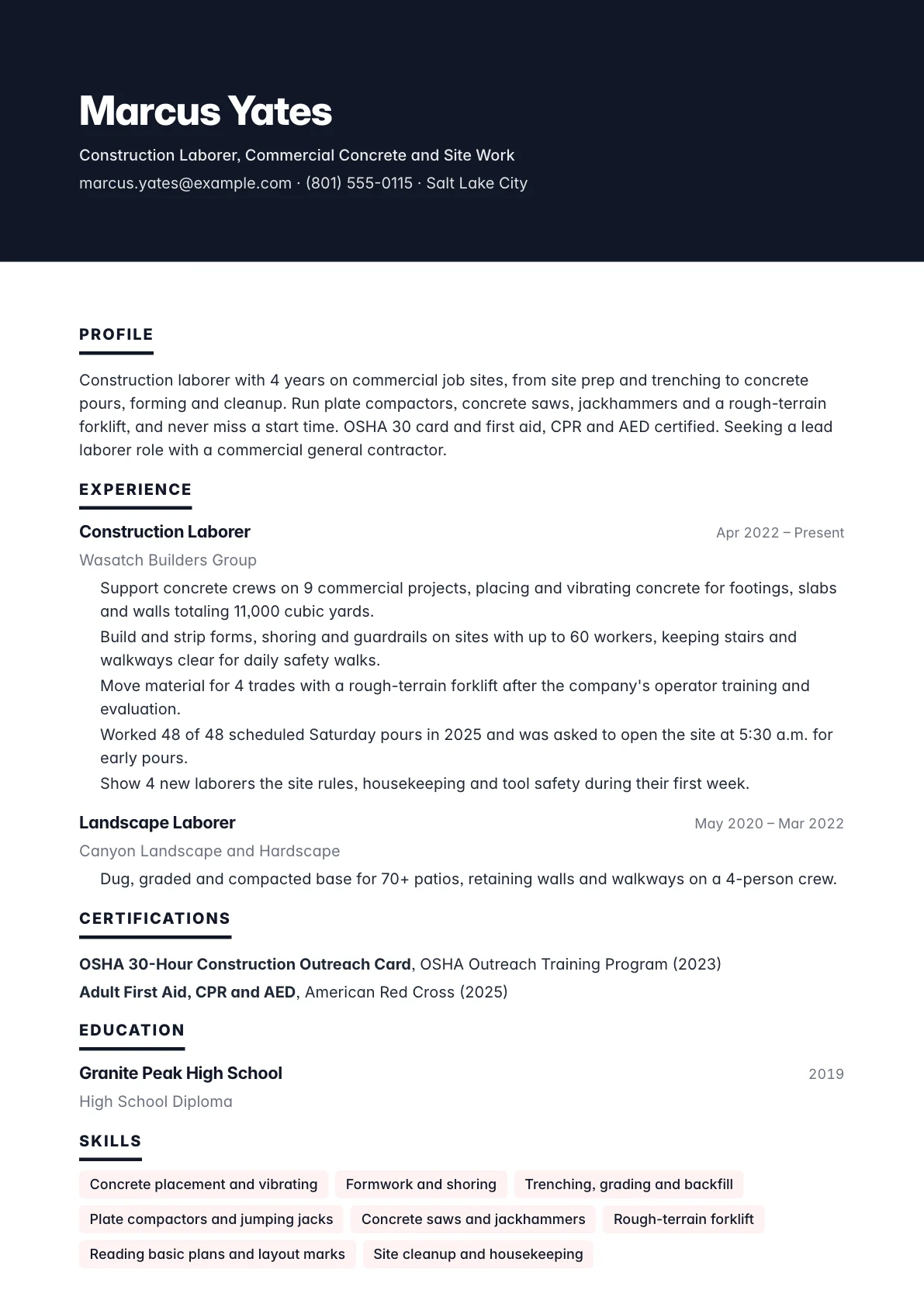
A commercial construction laborer with 4 years on job sites applying for a lead laborer position with a commercial general contractor.

Why this resume works

  • The first bullet gives the scale of the work (9 commercial projects, 11,000 cubic yards of concrete), which tells a superintendent he has been on real commercial sites.
  • Reliability is proven with numbers, not adjectives: 48 of 48 Saturday pours in 2025 and trusted to open the site at 5:30 a.m.
  • The OSHA 30 card and first aid certificate are listed with issuers and years, and the equipment he runs is named in both the bullets and the skills.
Edit & download this resume

Edit it in the free builder, then download the PDF with no watermark. A free account is only needed to download.

Hiring for construction laborers moves fast. A superintendent or a staffing coordinator needs people who will show up at 6 a.m., work safely, and already know the equipment, and they decide from a quick look at your resume and one phone call. That means your resume has to show three things right away: the kind of sites you have worked on, the tools and machines you can run, and your safety training.

This guide covers how to write a construction worker resume that does that, with or without years of experience: what to put first, bullets that turn site work into numbers, summaries for new, experienced and lead laborers, the skills and equipment contractors look for, and a full example for a commercial construction laborer in Salt Lake City. If you are aiming for a trade next, see the carpenter and electrician resume examples.

Construction worker pay and job outlook

Official figures for Construction Laborers and Helpers.

Median pay (2025)
$46,680 per year ($22.44 per hour)
Jobs in 2025
1,674,400
Job outlook, 2025 to 2035
6%, faster than average
Change in jobs, 2025 to 2035
+108,600
Typical entry-level education
Varies (see the BLS profile)
On-the-job training
Short-term on-the-job training

BLS counts construction workers as construction laborers and helpers, a group that includes helpers for trades such as electricians, carpenters and plumbers.

Sources: U.S. Bureau of Labor Statistics, Occupational Outlook Handbook: Construction Laborers and Helpers, checked September 2026; O*NET OnLine: Construction Laborers, checked September 2026.

How to write a construction worker resume

1

Put the kind of site work in your headline

Instead of just Laborer, write the work you do most: Construction Laborer, Concrete and Site Work, Demolition Laborer or Carpenter Helper, Residential Framing. It helps the right foreman pick you out of a stack.

2

Write a short summary about sites, equipment and safety

Two or three sentences: how long you have worked in construction and on what kind of projects (homes, commercial buildings, roads, utilities), the equipment you can run, your safety cards, and the job you want. Add that you have reliable transportation if the posting mentions it.

3

Give every job bullets with numbers

Count what you can: projects, cubic yards of concrete, feet of trench, square feet of demolition, crew size, workers on site, days without an incident. Placed concrete for 9 commercial projects is far stronger than helped with concrete.

4

Name the tools and equipment you run

Plate compactors, jumping jacks, concrete saws, jackhammers, power buggies, forklifts, skid steers, scissor lifts. If you were trained and evaluated by your employer to run a machine, say so. Contractors fill crews by who can run what.

5

List safety cards and certificates

OSHA 10 or 30, first aid and CPR, and any training for tasks such as rigging, scaffolding or aerial lifts, each with the organization and year. Put them just under your work history, or above it if you are new and they are your strongest selling point.

6

Keep it short and show you are reliable

One page, in plain words. Attendance, start times, weekend work and being trusted with keys or early openings all count as proof. If you are new, add related work like landscaping, moving, warehouse or farm jobs, since they show you can do physical work every day.

Skills and keywords for a construction worker resume

These skills and tools appear most often in construction laborer and helper postings. List the ones you can actually do on day one.

Hard skills

  • Site preparation and cleanup
  • Concrete placement, vibrating and finishing help
  • Building and stripping forms
  • Trenching, grading and compacting
  • Demolition and debris removal
  • Loading and unloading material
  • Setting up and taking down scaffolding with a competent person
  • Signaling equipment operators
  • Measuring and marking layout
  • Traffic control and flagging where trained

Soft skills

  • Showing up early, every day
  • Following directions from foremen and trades
  • Working safely and speaking up about hazards
  • Physical stamina in heat and cold
  • Teamwork on a busy site
  • Learning new tools quickly

Tools and software

  • Plate compactors and jumping jacks
  • Concrete saws, jackhammers and rotary hammers
  • Concrete vibrators and power buggies
  • Rough-terrain forklifts and skid steers
  • Scissor lifts
  • Laser levels and measuring tapes

Construction worker resume summary examples

Choose the level closest to yours and change the details to fit your own work.

Entry-level construction worker

Hardworking recent high school graduate with two summers on a landscaping crew, digging, grading and hauling material for residential yards. OSHA 10 card, reliable truck, and comfortable with plate compactors and hand tools. Seeking a general laborer job on a commercial or residential construction site, with interest in a carpentry apprenticeship.

Experienced construction laborer

Construction laborer with six years on highway and utility projects, installing storm drain pipe, setting trench boxes and running compaction equipment. Trained to work around heavy equipment and live traffic, with no recordable incidents. OSHA 30 card. Seeking a pipe laborer or utility crew role.

Lead laborer or labor foreman

Lead laborer with 11 years in commercial construction, directing crews of up to 8 on concrete, cleanup and material handling for projects over $30 million. Plan daily labor needs with the superintendent, run morning safety huddles and train new hires. Seeking a labor foreman role with a general contractor.

Construction worker resume bullet examples

Each bullet names the work, adds a number and, where possible, a result. Borrow the shape and use your own facts.

  • Dug and shored 1,200 feet of utility trench with trench boxes, working alongside excavator operators.
  • Removed interior walls, ceilings and flooring from 25,000 square feet of office space during a gut renovation, sorting debris for recycling.
  • Installed 3,000 feet of silt fence and inlet protection to meet the site's storm water plan.
  • Unloaded and staged 20+ deliveries a week, keeping the laydown yard organized so crews found material fast.
  • Set and moved traffic control devices on a 2-mile road widening project, with no incidents over 14 months.
  • Helped pour and finish 40 residential driveways and garage slabs in one season.
  • Built temporary guardrails and hole covers on 5 floors of a new hotel before trades moved in.
  • Kept daily cleanup logs that helped the site pass 12 owner safety audits in a row.
  • Ran a skid steer to grade and backfill around 16 new townhome foundations.
  • Trained 6 new laborers on tool safety and housekeeping during a busy summer hiring push.
  • Worked 50 to 60 hours a week during a 3-month schedule push without a missed shift.

Safety cards, certifications and training for construction workers

Construction laborers usually learn on the job. The Bureau of Labor Statistics says employers often require safety training that meets OSHA guidelines, before or after hiring, may require a valid driver's license, and that some workers earn optional certifications for tasks like rigging or scaffolding. Some laborers also complete apprenticeships, usually sponsored by local unions or trade associations. What to list:

  • OSHA 10-hour or 30-hour Construction Outreach card from the OSHA Outreach Training Program: the 10-hour class is hazard awareness for workers, and the 30-hour class is aimed at supervisors and workers with safety duties. OSHA calls it voluntary training and not a certification, but many contractors, and some states and cities, require the card.
  • First aid, CPR and AED: from an organization such as the American Red Cross, with the year you completed it.
  • Equipment training: forklifts, skid steers, aerial lifts and other machines you were trained and evaluated on, with who trained you and when.
  • Task certifications: rigging, signal person, scaffolding or flagging, where you hold them. Rules for some of these differ by state, so use the exact name on your card.
  • Apprenticeship or pre-apprenticeship: if you are in a laborers' or trade apprenticeship, list the program and your hours. Apprenticeship.gov's job finder lists registered programs.

The example, line by line

The example is for Marcus, a commercial construction laborer in Salt Lake City with 4 years on sites who wants to be a lead laborer. Here is what each part does.

Headline: Construction Laborer, Commercial Concrete and Site Work. A superintendent can see what crew he fits on.

Summary: 4 years and the work he does, then the equipment he runs, then his OSHA 30 card and first aid certificate, then the role he wants.

Current job: five bullets. 9 projects and 11,000 cubic yards give the scale. Forms and guardrails on sites with up to 60 workers show he works safely around others. The forklift bullet names the training and evaluation. 48 of 48 Saturday pours and the 5:30 a.m. openings prove reliability, and showing 4 new laborers the ropes shows he is ready to lead.

Earlier job: one line of landscape work, 70+ patios and walls on a 4-person crew, which shows two more years of physical site work.

Certificates, education and skills: his cards with issuers and years (2023 and 2025), his high school diploma from 2019, and eight skills that name tools a foreman needs.

Mistakes that cost construction workers interviews

  • Writing general labor and nothing else. Say which work: concrete, demolition, framing help, site cleanup, utilities.
  • Leaving out equipment. Foremen fill crews by who can run the compactor or the forklift. Name every machine you are trained on.
  • Using adjectives instead of proof. Hard worker means little. Worked 48 of 48 Saturday pours means a lot.
  • Forgetting safety cards. An OSHA card or first aid certificate can be the reason you get the call. List them with the year.
  • Skipping non-construction work. Landscaping, moving, warehouse and farm jobs show you can do hard physical work. Include them if you are new.

Other trades resume examples that are close to this one:

Every example is in the resume examples hub, grouped by job and situation.

Build it free, no watermark

CVPoet's resume builder is free to use without an account. Start from this example or a blank page, pick one of four ATS-friendly designs, and download a PDF with no watermark on any plan.

Frequently asked questions

What should a construction worker put on a resume?

Your contact details, a headline with the kind of site work you do, a short summary, each job with numbers (projects, crew size, amounts of material), your safety cards and certificates, and the tools and equipment you can run.

How do I write a construction resume with no experience?

Lead with anything physical you have done: landscaping, moving, farm work, warehouse shifts, helping a family member build or repair. Add an OSHA 10 card if you can get one, a driver's license and reliable transportation, and a summary saying you are ready to learn on site.

Do I need an OSHA card to work in construction?

OSHA says its Outreach program is voluntary, but many contractors ask for an OSHA 10 or 30 card, and some states and cities require one on certain jobs. If you have one, list it by its full name.

What is the difference between OSHA 10 and OSHA 30?

OSHA describes the 10-hour class as hazard awareness for workers and the 30-hour class as better for supervisors or workers with safety responsibilities. A lead laborer or foreman candidate should have OSHA 30.

What skills should I list on a construction worker resume?

The tasks you do (concrete, forming, trenching, demolition, cleanup), the equipment you run, reading basic plans, and safety habits. Show reliability in your bullets with attendance or weekend work.

Should I list forklift or equipment training?

Yes. Name the machine, who trained and evaluated you, and when. Being able to run a forklift, skid steer or lift makes you more useful on day one.

How long should a construction worker resume be?

One page. Superintendents and staffing coordinators read quickly, so keep it short and put your equipment and safety cards where they are easy to see.

Should I include my high school diploma?

Yes, if you have one, in one line. Some apprenticeship programs require a diploma or equivalent, so it helps if you plan to move into a trade.

How do I show I am ready to be a lead laborer?

Show the parts of the job you already do: training new hires, opening the site, running a small crew on a task, keeping material organized. Put a number on each.

Can I use a resume template with columns?

It is safer not to. Many contractor and staffing agency application systems read columns out of order. A single-column layout like this example works everywhere, and all CVPoet templates are single column.

Build your construction resume now

Start from Marcus's example or a blank page. Free, no account needed, and the PDF has no watermark.

Build your resume, free
Construction worker resume example
Construction worker resume example The example above as an image, to save or share. To change it, use Edit & download this resume at the top of the page. Open the full-size image