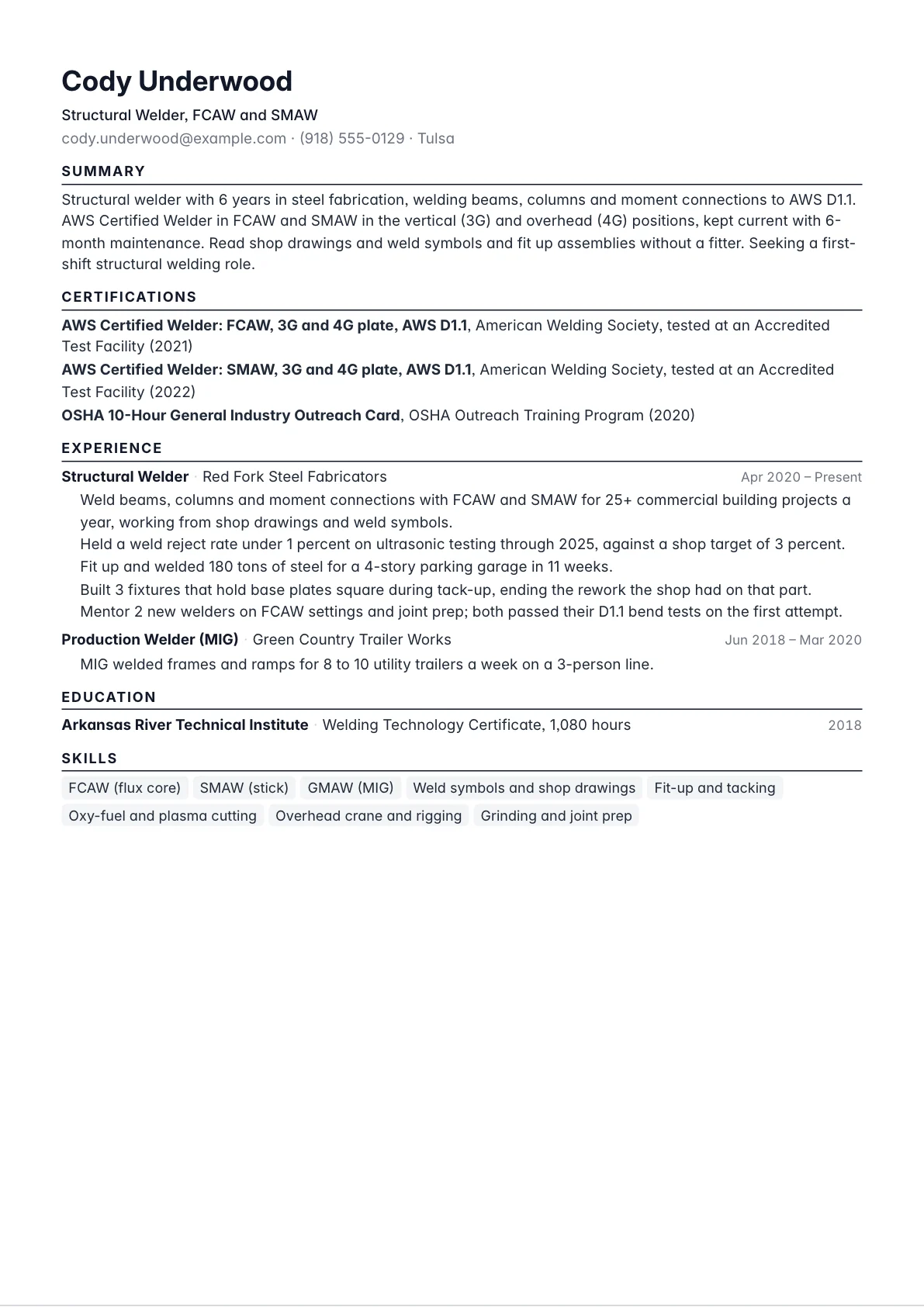
What a foreman, fleet manager or supervisor checks first
In the trades the first reader is often a recruiter or office manager with a checklist, and the second is the person who will put you to work. Give both of them what they need on the first page:
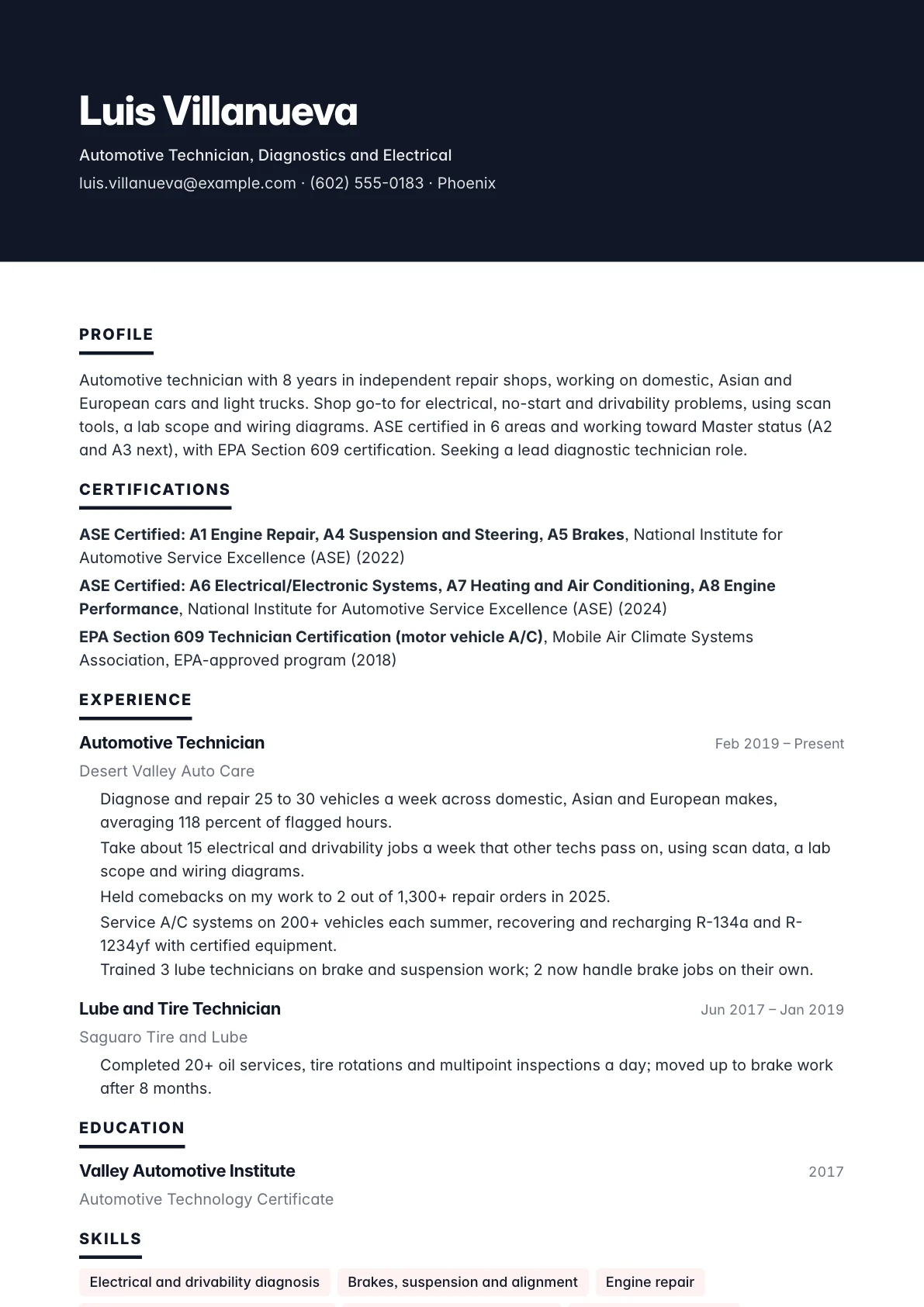
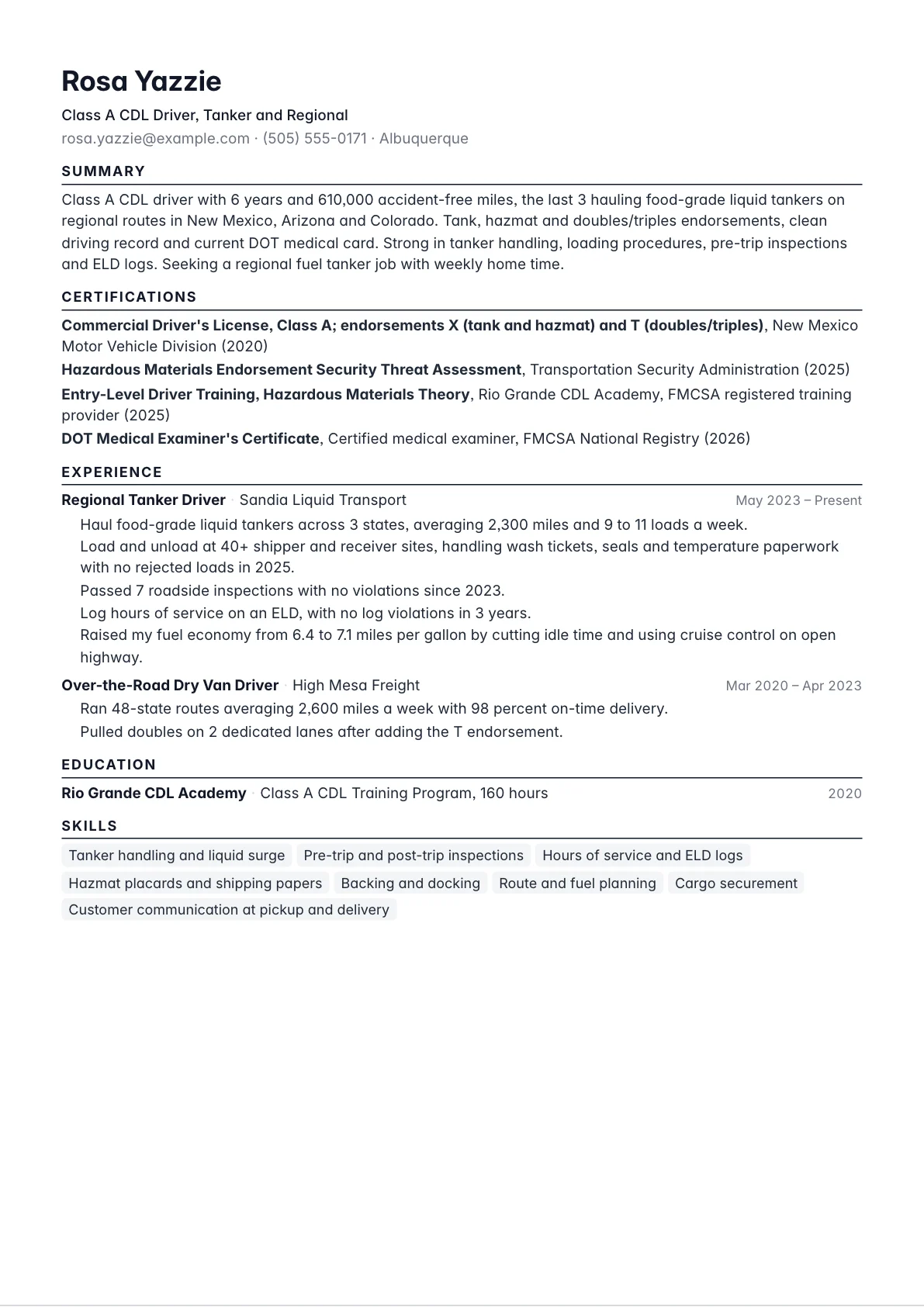
- Your credential in writing. License level and state for an electrician, CDL class and endorsements for a driver, process, position and code for a welder, ASE test numbers for a mechanic. Put it in its own section right after the summary, with the issuer and the year.
- The kind of work, not just the title. A residential service electrician and an industrial one are hired for different jobs. So are a framer and a finish carpenter, or a local route driver and an over-the-road tanker driver. Say which in the headline.
- Numbers from the job. Square feet framed, conduit run, cars a week and comebacks, safe miles, stops per day, pallets per shift, order accuracy. Delivered 140 to 160 stops a day with 99.8 percent scan accuracy tells a dispatcher exactly what you do.
- Safety and attendance. Clean inspections, no preventable accidents, zero lost-time injuries, perfect attendance through peak season. On a crew or a dock, these are the numbers a supervisor trusts most.
Name your own tools and the equipment you are trained on, and keep everything in one column. Many contractors and staffing agencies take applications through online systems, and those read a plain layout best.
Licenses, cards and certifications by job
Some of these jobs need a state or local license, some follow federal rules, and some ask for nothing beyond the employer's own training. Each example page covers its own requirements with official sources. The short version:
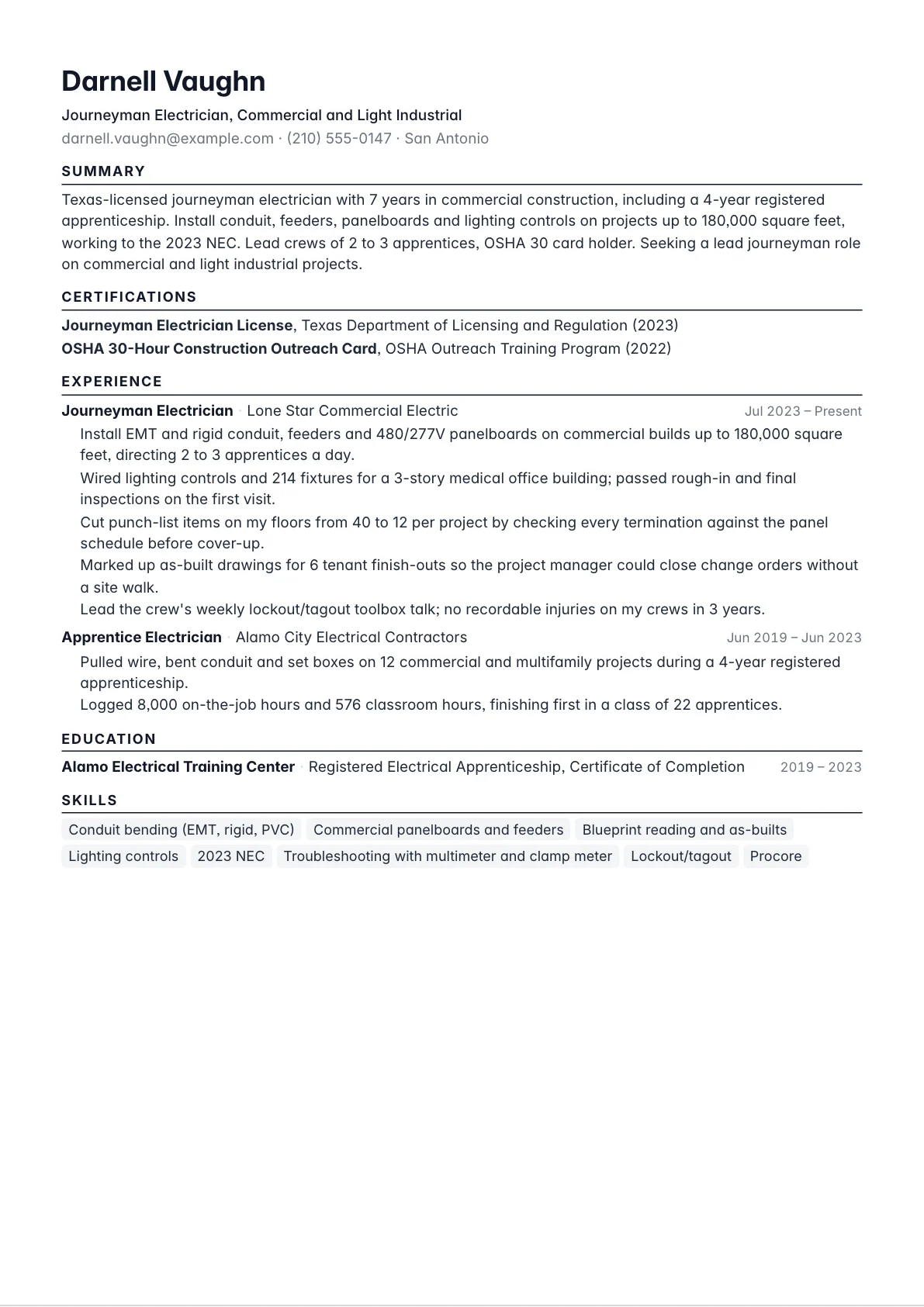
- Electrician: most states require a license, with levels like apprentice, journeyman and master set by your state or local board. Most electricians learn through an apprenticeship that the Bureau of Labor Statistics describes as 4 or 5 years.
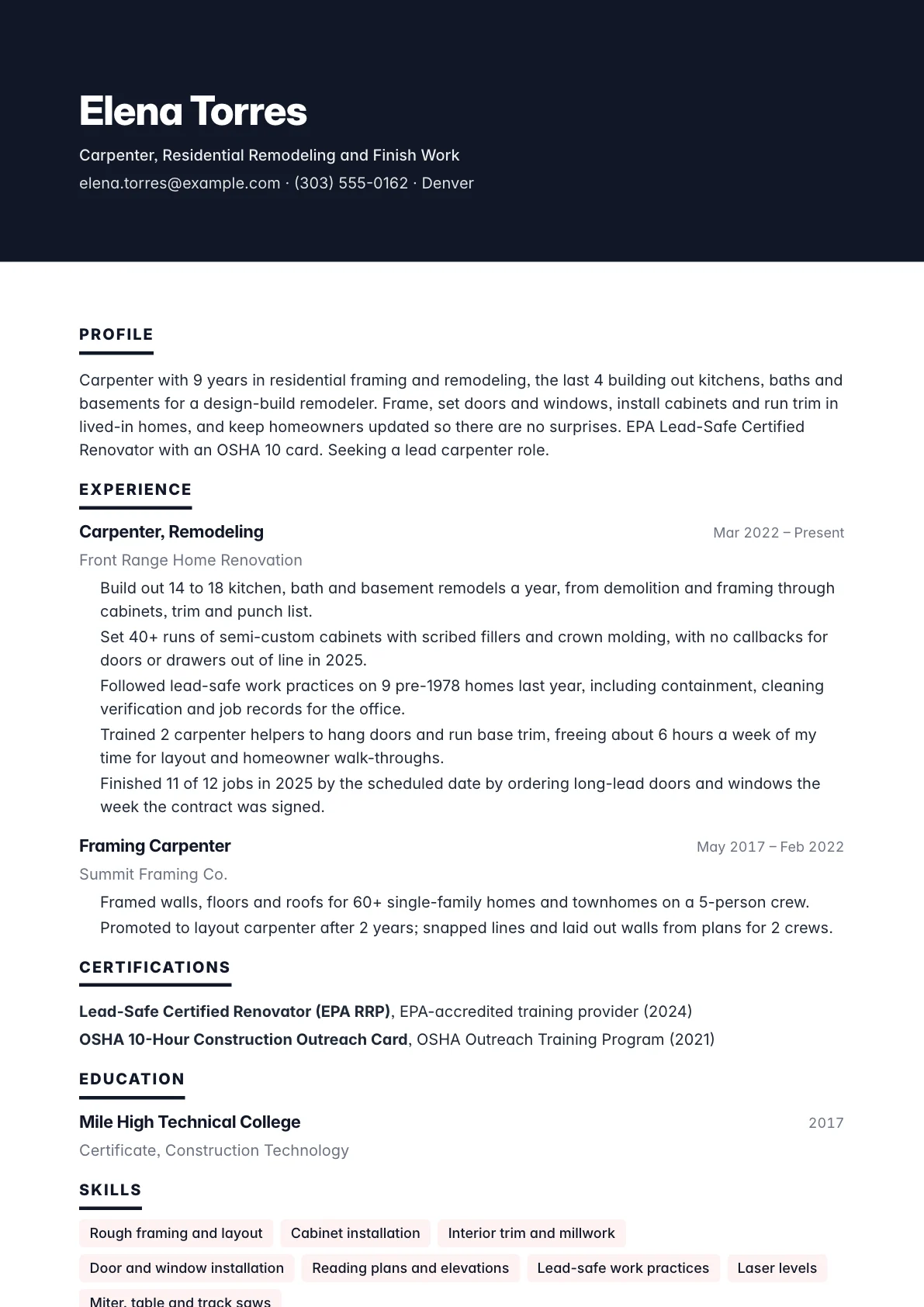
- Carpenter: no national license. Apprenticeship or on-the-job training, an OSHA card, and EPA Lead-Safe renovator certification for paid work that disturbs paint in homes built before 1978.
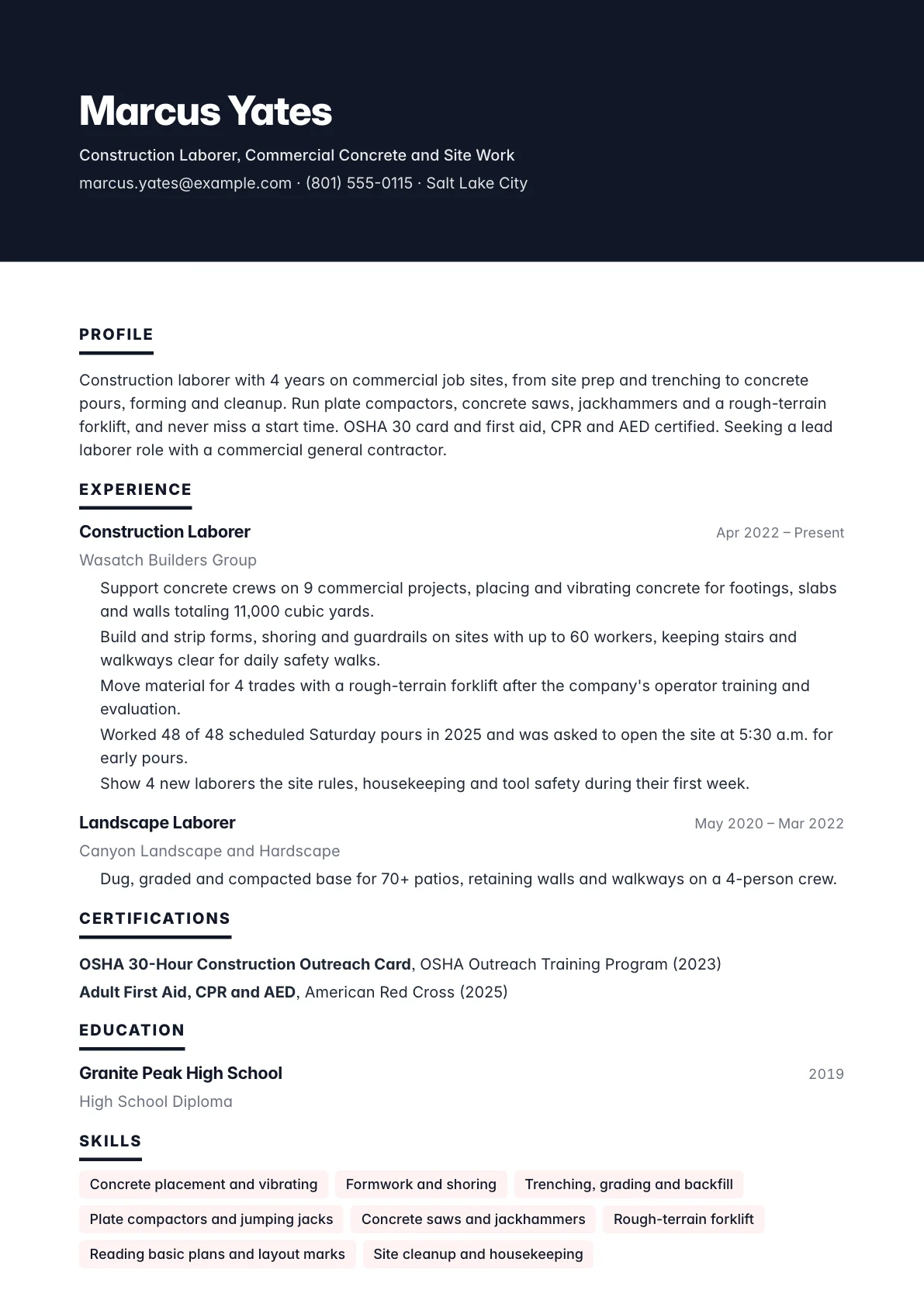
- Construction worker: learned on the job. Many contractors ask for an OSHA 10 or 30 card, plus equipment training and task certifications such as rigging.
- Welder: a performance test such as the AWS Certified Welder, or an employer qualification to a code like AWS D1.1. A license is needed only in some states and localities.
- Mechanic: ASE certifications, valid for five years, and EPA Section 609 certification to service vehicle A/C systems for pay.
- Truck driver: a state-issued CDL under federal standards, any endorsements, a DOT medical card, and Entry-Level Driver Training for new Class A and B licenses.
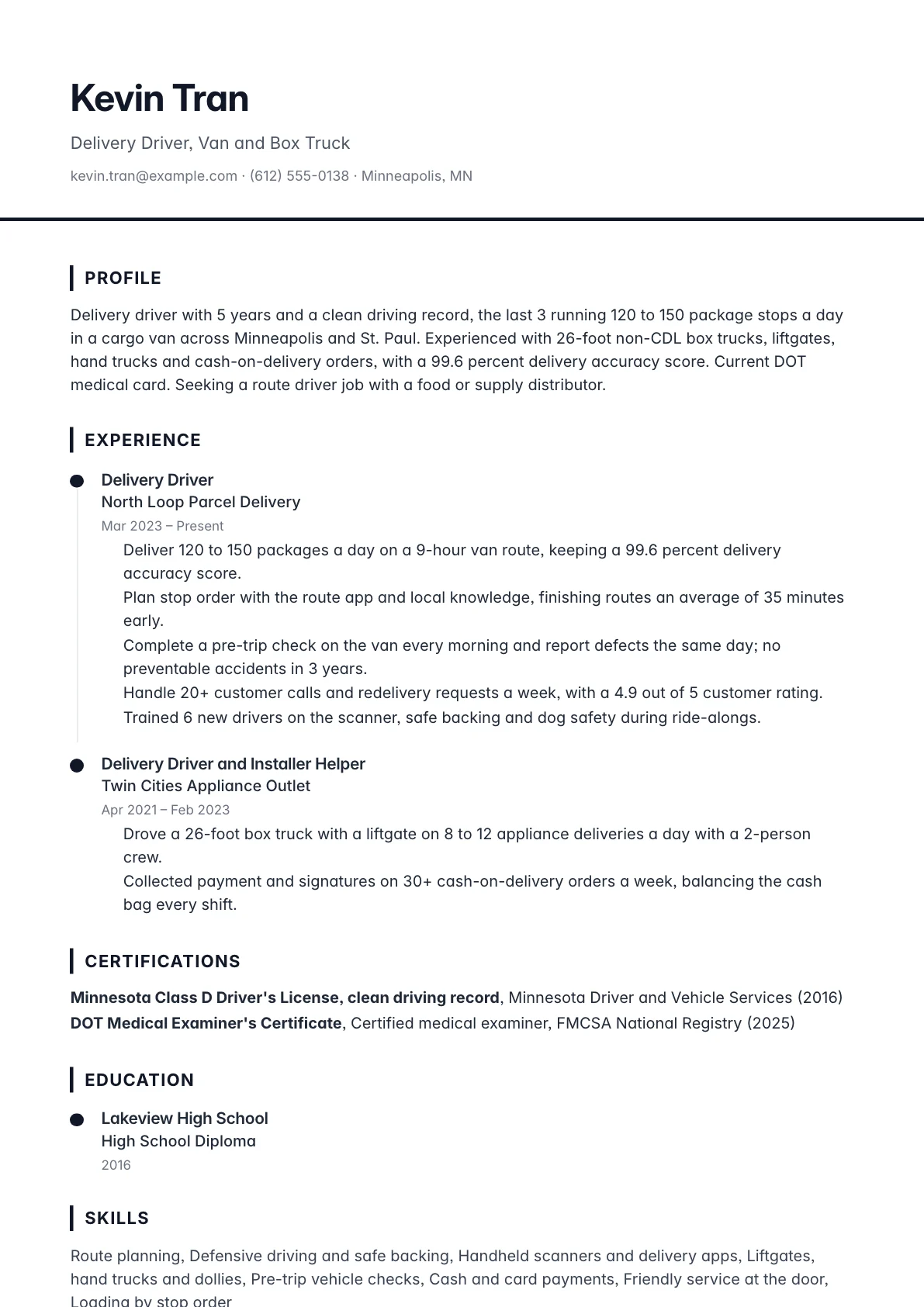
- Delivery driver: a regular driver's license for most vans. A CDL is needed only for heavier vehicles, and a DOT medical card for vehicles of 10,001 pounds or more in interstate work.
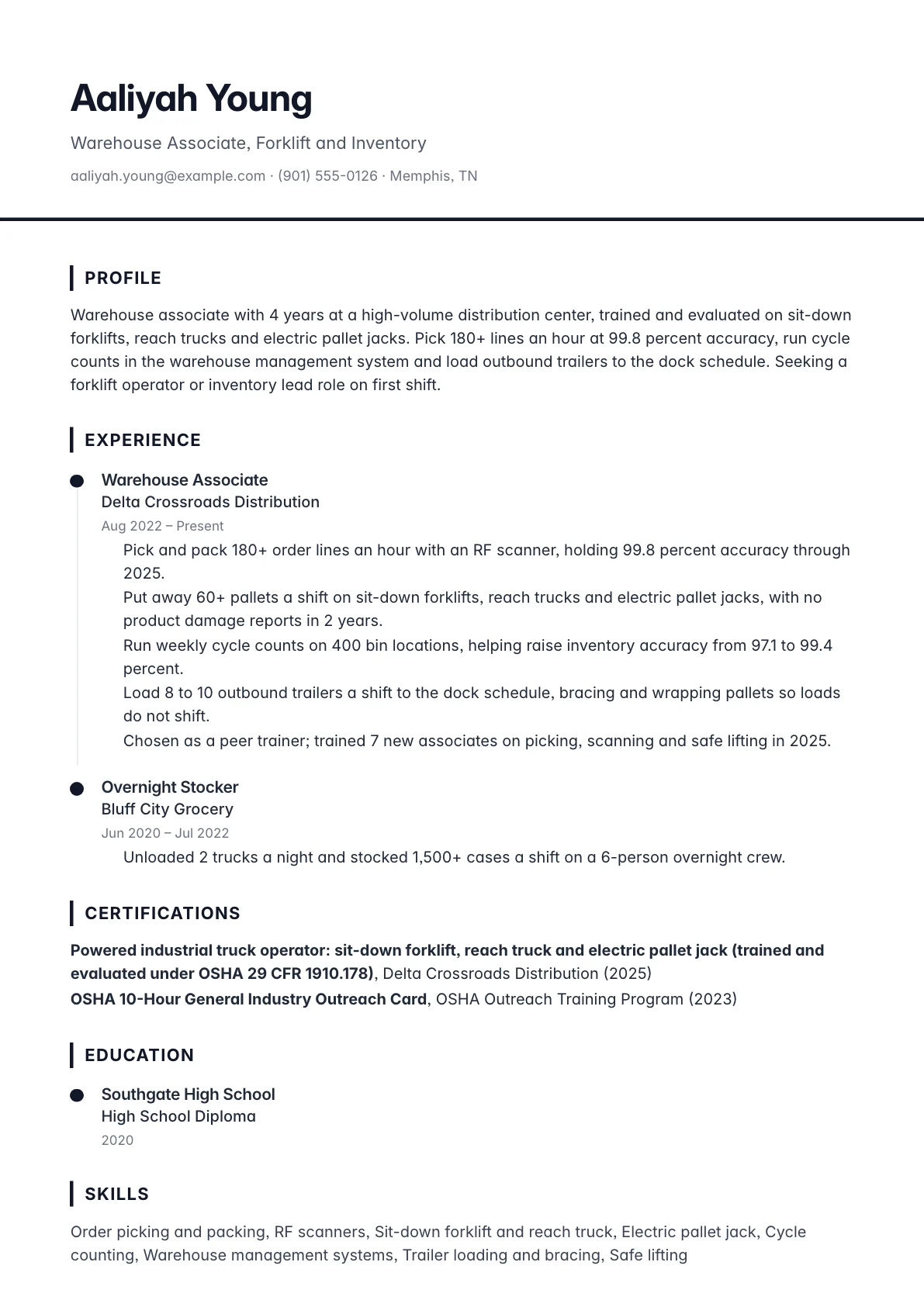
- Warehouse worker: no license. Forklift operators are trained, evaluated and certified by the employer under OSHA's powered industrial truck rule.
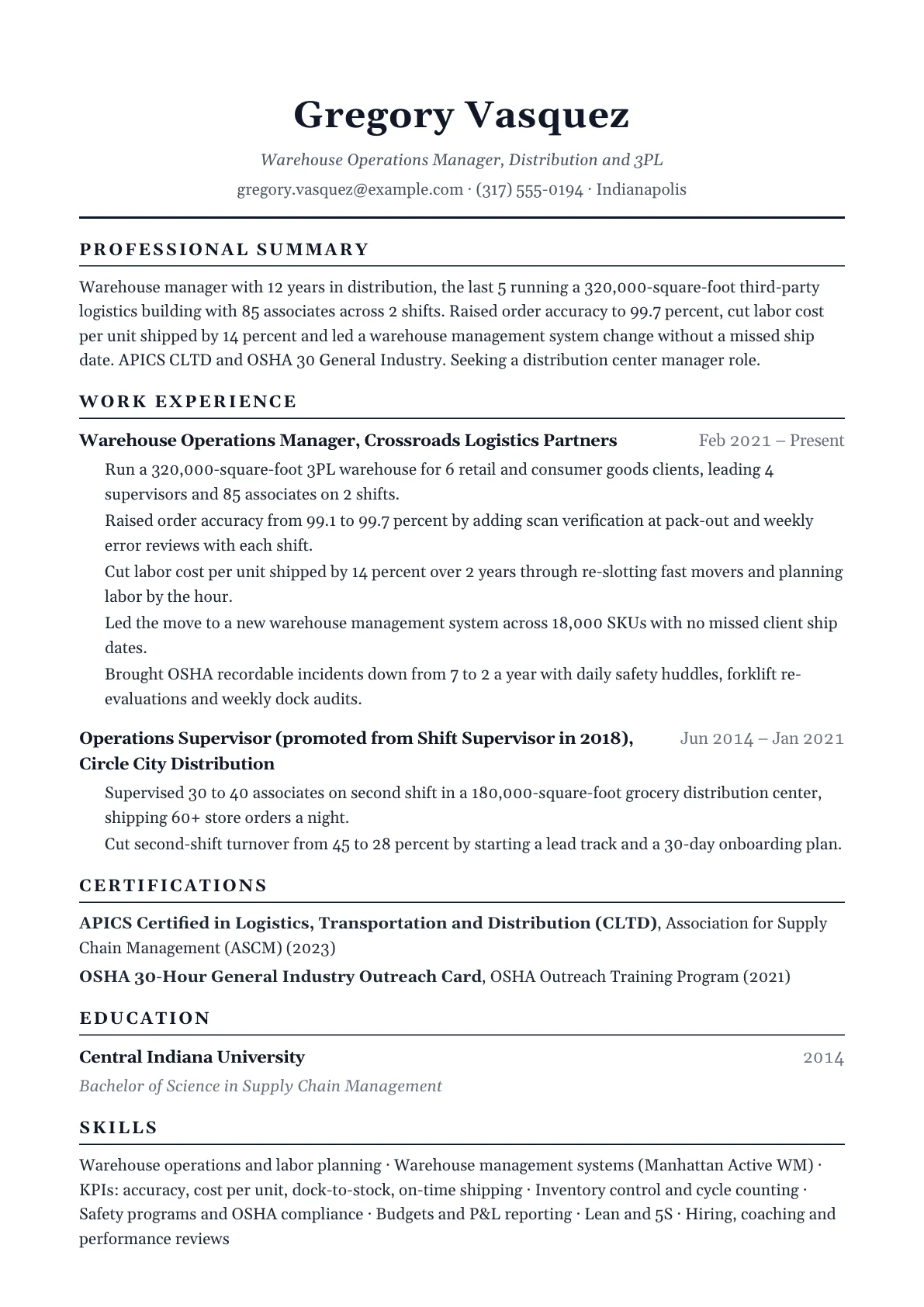
- Warehouse manager: no license. Optional certifications such as APICS CLTD from ASCM and an OSHA 30 card carry weight.
Two federal programs come up across many of these jobs. The OSHA Outreach Training Program offers 10-hour and 30-hour safety classes; OSHA calls it voluntary and not a certification, so list it as a card, not a license. And Registered Apprenticeship programs, searchable on Apprenticeship.gov from the U.S. Department of Labor, pair paid work with classroom instruction.
Which example should you start from?
Choose the job you are applying for. If you are moving between trades, these paths are common:
- Getting on a crew. The construction worker example shows how to present site work, equipment and safety cards when you are starting out. The no experience guide helps if you have never held a paid job.
- From helper to licensed trade. Once you are in an apprenticeship, move to the electrician or carpenter example and show your hours and year in the program.
- From the van to the rig. Many delivery drivers move on to a CDL. The delivery driver and truck driver examples show how the resume changes when you add a license class.
- From the floor to the office. A lead ready to run a shift or a building should start from the warehouse manager example and put the numbers they already own first.
- Leaving the military. If you drove, repaired or moved equipment in the service, the military to civilian guide shows how to describe it in civilian words.
Trades, transport and logistics jobs in numbers
These jobs fall into four groups in the U.S. Bureau of Labor Statistics Occupational Outlook Handbook. From 2025 to 2035 it projects:
- Construction and extraction: faster than average growth, about 587,000 openings a year, median wage $59,540.
- Installation, maintenance and repair: faster than average growth, about 569,000 openings a year, median wage $59,620.
- Transportation and material moving: growth about as fast as average, about 1.6 million openings a year, median wage $44,350.
- Production, which includes welders: little or no change, about 867,700 openings a year, median wage $46,990.
The wages are for May 2025, when the median for all occupations was $50,980. Warehouse managers are counted with managers, so their own row in the table above is the figure to use.
Frequently asked questions
What should I put at the top of a trades resume?
Your name, phone number, city and email, a headline with your trade and level, a short summary, and then your license, CDL or certifications. For licensed work the credential is screened first, so it goes above your job history.
How do I list apprenticeship hours on a resume?
In the apprenticeship entry, as numbers: on-the-job hours, classroom hours, your year in the program and the sponsor. If you have not finished, give the hours so far and your expected completion date.
Should I put an OSHA 10 or OSHA 30 card on my resume?
Yes, if you have one. Write the full name, such as OSHA 10-Hour Construction Outreach card, and the year. OSHA describes the program as voluntary training rather than a certification, but many employers ask for the card.
Should I mention that I have my own tools or truck?
Yes, in one line in your summary or skills. Many carpenter, mechanic and trade postings ask about your own hand tools, power tools, scan tools or reliable transportation, and answering up front saves a phone call.
How do I show safety on a trades resume?
With a record: years or miles without a preventable accident, zero lost-time injuries, clean inspections, passed weld tests. Add the safety training you hold by its real name. Numbers are more convincing than calling yourself safety conscious.
Do I need a CDL to drive a box truck or delivery van?
Usually not. Under federal rules a CDL is needed for a single vehicle rated at 26,001 pounds or more, heavier truck and trailer combinations, or vehicles carrying 16 or more people or placarded hazardous materials. Check the vehicle's weight rating, and see the delivery driver example for the medical card rule.
How do I write a trades resume with no experience?
Lead with any trade school, shop class, pre-apprenticeship or safety card, then list physical work you have done: landscaping, moving, farm work, warehouse shifts, fixing cars or helping a relative build. Add your driver's license and say you are ready to learn on the job.
Should I list union membership on my resume?
If it helps with the job you want, yes: a union apprenticeship or local shows where you trained. For non-union contractors you can list the training program itself and leave the local number off.
Where do the pay and outlook figures come from?
From the U.S. Bureau of Labor Statistics Occupational Outlook Handbook. Each example page links its exact source and shows the month the figures were checked.
Build your trades resume
Start from one of the examples above or an empty page. The builder costs nothing, needs no account, and your PDF has no watermark.
Build your resume, free