Data Engineer Resume: Examples (2026)

Data engineer resume example with pipeline, SQL, Spark and cloud skills, summary and bullet examples, certifications, official pay data and a free template.

Template:

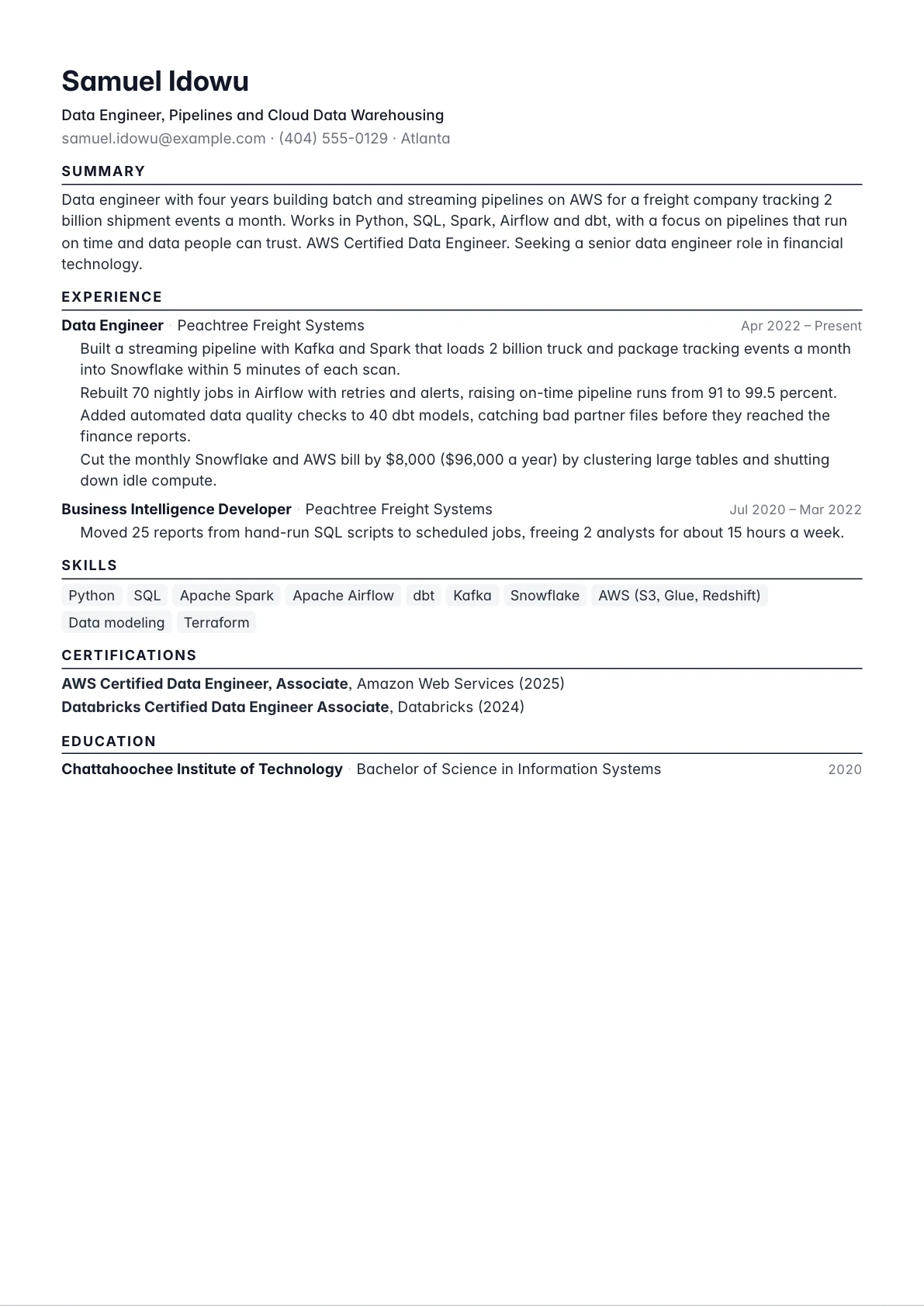
A data engineer with four years at a logistics company applying for a senior data engineer role at a financial technology company.

Why this resume works

  • The bullets lead with volume and reliability, the two things a data team is judged on: 2 billion tracking events a month, and on-time pipeline runs up from 91 to 99.5 percent.
  • The tools (Spark, Airflow, dbt, Snowflake, AWS) are named inside the bullets as well as in the skills list, so each one is tied to real work.
  • The data quality checks and the cost cut of $96,000 a year show judgment beyond writing code, which is what separates a senior data engineer.
Edit & download this resume

Edit it in the free builder, then download the PDF with no watermark. A free account is only needed to download.

Data engineers build the plumbing behind every report and prediction a company makes. They write the pipelines (automated steps that copy data from apps, websites and partners, clean it and load it into one place), design the data warehouse where analysts query it, and keep all of it running on time. When a pipeline breaks, the sales report is wrong by 9 a.m. That is why hiring managers reading a data engineer resume look for three things: the volume you handle, how reliable your pipelines are, and the tools you built them with.

This guide covers the sections that work, the skills and tools postings ask for with plain explanations, summary and bullet examples at each level, optional cloud and platform certifications, and a full example for a data engineer at a logistics company applying for a senior role. If your work is closer to reporting and analysis, the data analyst resume example fits better.

Data engineer pay and job outlook

Official figures for Database Administrators and Architects.

Median pay (2025)
$126,760 per year ($60.94 per hour)
Jobs in 2025
144,500
Job outlook, 2025 to 2035
4%, as fast as average
Change in jobs, 2025 to 2035
+6,500
Typical entry-level education
Bachelor's degree
Work experience needed
Varies (see the BLS profile)

Data engineer is not a separate official occupation. The Bureau of Labor Statistics groups this work with database administrators and architects, and O*NET lists Data Engineer as a reported job title for Database Architects.

Sources: U.S. Bureau of Labor Statistics, Occupational Outlook Handbook: Database Administrators and Architects, checked September 2026; O*NET OnLine: Database Architects, checked September 2026.

How to write a data engineer resume

1

Headline the kind of data engineering you do

Data engineering covers batch jobs that run overnight, streaming systems that handle data in seconds, warehouses, and the platforms under them. Write Data Engineer plus your focus, such as Pipelines and Cloud Data Warehousing or Streaming and Kafka, so the reader knows where you fit.

2

Open the summary with volume and stack

Your first sentence should give years, the kind of data and its size: 2 billion shipment events a month, 400 source tables, 30 terabytes. The second names your main languages and tools. The third gives a certification, if any, and the role you want. Scale is the fastest way for a manager to judge your level.

3

Write bullets about reliability, speed, cost and trust

Data teams are judged on whether data arrives on time, how fresh it is, what it costs and whether people trust it. Build your bullets around those: on-time run rates, minutes from event to report, monthly cloud spend, data quality checks added, incidents avoided. Start each with an action and name the tool you used.

4

Explain who used the data

A pipeline matters because someone depends on it. Say who: the finance team closing the books, the pricing model, the operations dashboard. Catching bad partner files before they reached the finance reports tells a hiring manager you think about the people downstream, not only the code.

5

Group skills so they are easy to scan

List ten to fifteen skills: languages (Python, SQL, Scala), processing tools (Spark, Kafka), orchestration (Airflow, the scheduler that runs jobs in order), warehouses (Snowflake, BigQuery, Redshift), cloud platform and infrastructure tools such as Terraform. Use the posting's spelling and leave out tools you only tried once.

6

Add certifications, education and, if new, projects

Cloud and platform certifications fit well near the end with their year. Put your degree last once you have experience. New data engineers and people moving from analyst roles should add a project that builds a real pipeline end to end, with a link to the code and a short readme.

Skills and keywords for a data engineer resume

These skills come up most often in data engineer postings. Use the ones you have, in the posting's wording, and show the main ones inside your bullets.

Hard skills

  • Advanced SQL, including window functions and query tuning
  • Python for pipelines and automation (Scala or Java in some teams)
  • ETL and ELT: extracting data, transforming it and loading it into a warehouse
  • Data modeling: designing tables so data is easy and fast to query
  • Distributed processing with Apache Spark
  • Streaming data with Kafka or Amazon Kinesis
  • Orchestration with Airflow, Dagster or Prefect (tools that run jobs in order)
  • Data warehouses and lakehouses: Snowflake, BigQuery, Redshift, Databricks
  • Data quality testing and monitoring
  • Infrastructure as code with Terraform

Soft skills

  • Talking with analysts and data scientists to learn what they need
  • Owning pipelines, including fixing them when they fail
  • Writing clear documentation for tables and jobs
  • Weighing speed against cost
  • Careful handling of sensitive data
  • Explaining delays and tradeoffs to non-technical teams

Tools and software

  • dbt for SQL transformations and tests
  • Apache Airflow
  • Snowflake, BigQuery or Amazon Redshift
  • Databricks and Apache Spark
  • AWS (S3, Glue, Lambda), Google Cloud or Microsoft Azure
  • Git and GitHub Actions or another CI/CD tool

Data engineer resume summary examples

Pick the one nearest your level and swap in your own details. Each gives the data you handle, the size, your tools and the job you want.

Entry-level data engineer

Computer science graduate with a data engineering internship at a health insurer, where I built an Airflow pipeline that loads 300,000 claims a day into BigQuery. Skilled in Python, SQL and dbt, and built a personal project that streams public transit data into a live dashboard. Seeking a junior data engineer role.

Experienced data engineer

Data engineer with five years building pipelines for an online marketplace, moving data from 60 source systems into Snowflake for 200 analysts. Rebuilt the core order tables in dbt with tests on every model and cut the nightly load from 4 hours to 50 minutes. Seeking a data engineer role on a platform team.

Senior data engineer

Senior data engineer with ten years, leading a team of four that runs the data platform for a streaming media company handling 20 terabytes a day. Designed the move from an on-premises Hadoop cluster to a cloud lakehouse and set the standards for data quality and access control. Seeking a staff or lead data engineer position.

Data engineer resume bullet examples

Each bullet names the pipeline or system, the tool and a number. Keep the shape and use your own facts.

  • Built 35 ELT pipelines in dbt and Airflow feeding the company's Snowflake warehouse from 12 source systems.
  • Reduced the nightly warehouse load from 6 hours to 70 minutes by switching large tables to incremental loads.
  • Designed a customer data model used by 3 analytics teams, replacing 9 inconsistent versions of the same table.
  • Set up a Kafka stream that makes payment events available for fraud checks within 30 seconds.
  • Moved 150 terabytes of historical data from an on-premises Hadoop cluster to Amazon S3 in 4 months without losing a record.
  • Added freshness and row-count alerts to 60 tables, so problems reach the team before the business notices.
  • Cut BigQuery costs by 35 percent by partitioning tables and rewriting the 20 most expensive queries.
  • Automated the monthly regulatory data extract, turning 3 days of manual work into a 2-hour scheduled job.
  • Wrote Terraform for all data infrastructure, letting the team rebuild a test environment in 20 minutes.
  • Documented 200 warehouse tables with owners and definitions, cutting analyst questions to the team by half.
  • Mentored 2 analysts who moved into data engineering roles within a year.

Certifications for data engineers

No license is required to work as a data engineer, and most employers hire on experience. Certifications are optional, but cloud and platform certifications are common in data engineer postings, because they show you can work on the exact service the team uses. Choose the one that matches the employer's platform:

  • AWS Certified Data Engineer, Associate from Amazon Web Services: covers building pipelines, data stores and data quality on AWS. AWS recommends two to three years of data engineering experience and says the certification is valid for three years.
  • Professional Data Engineer from Google Cloud: for teams on BigQuery and Google Cloud. Google says it is valid for two years.
  • Microsoft Certified: Fabric Data Engineer Associate from Microsoft, earned by passing exam DP-700: for teams using Microsoft Fabric and Azure. Microsoft certifications like this one expire unless renewed through a free online assessment.
  • Databricks Certified Data Engineer Associate from Databricks: for teams that run Spark on Databricks. Databricks says recertification is required every two years.

The example, line by line

The example is for Samuel, a data engineer with four years at a freight company who wants a senior role in financial technology. Here is what each part does.

Headline: Data Engineer, Pipelines and Cloud Data Warehousing. It tells the recruiter his focus in one short line.

Summary: the first sentence gives the scale (2 billion shipment events a month) and the platform (AWS). The second lists his tools and what he cares about. The third names his AWS certification and the industry he is aiming for.

Experience: four bullets, each on a different thing data teams are judged by. Speed: events reach Snowflake within 5 minutes. Reliability: 70 jobs rebuilt and on-time runs from 91 to 99.5 percent. Trust: quality checks on 40 dbt models. Cost: $8,000 a month saved. A fintech manager cares about all four. His earlier business intelligence role keeps one bullet (25 reports automated, freeing 2 analysts), which also explains how he moved into engineering.

Skills: ten tools, each one used somewhere in his bullets.

Certifications and education: AWS from 2025 and Databricks from 2024, then his information systems degree from 2020.

Mistakes that cost data engineers interviews

  • No sense of scale. Built data pipelines could mean one spreadsheet or a billion events. Give rows, events, tables, terabytes or source systems.
  • A tool list that reads like a buzzword cloud. Listing every Apache project suggests you have used none of them deeply. Keep the ones you could explain in an interview.
  • Only describing the build. Managers also want to know that your pipelines kept running. Add on-time rates, alerts you set up and incidents you prevented.
  • Ignoring cost. Cloud data work can get expensive fast. A bullet about saving money on compute or storage is one of the strongest a data engineer can write.
  • Calling yourself a data engineer for analyst work. If you mostly wrote reports, say so and show the engineering parts honestly. Titles that do not match the bullets raise doubts.

Other tech resume examples close to this one:

Every example is in the resume examples hub, grouped by job and situation.

Build it free, no watermark

CVPoet's resume builder is free to use without an account. Start from this example or a blank page, pick one of four ATS-friendly designs, and download a PDF with no watermark on any plan.

Frequently asked questions

What should a data engineer put on a resume?

Contact details, a headline with your focus, a short summary with the scale you work at, your experience with bullets about speed, reliability, cost and data quality, a skills section, any cloud certifications, and your education.

What skills are most important for a data engineer?

SQL and Python first, then data modeling, a processing tool such as Spark, an orchestration tool such as Airflow, a warehouse such as Snowflake or BigQuery, and one cloud platform. Streaming tools like Kafka matter for real-time roles.

How do I become a data engineer with no experience?

Most data engineers start as analysts, BI developers or software engineers. Show the engineering side of that work: automated jobs, SQL you optimized, scripts you wrote. Add a project that builds a pipeline end to end, and consider a cloud data certification.

Which data engineering certification is best?

The one for the platform the employer uses: AWS Certified Data Engineer for AWS, Google Cloud Professional Data Engineer for BigQuery, Microsoft Fabric Data Engineer for Microsoft shops, or Databricks for Spark on Databricks. All are optional.

How do I show impact as a data engineer?

Measure what the business feels: data arriving earlier, fewer failed runs, lower cloud bills, fewer wrong numbers in reports, and hours of manual work removed. Name the team that uses the data.

How long should a data engineer resume be?

One page for most people with under ten years of experience. Senior and staff engineers can use two, with the most recent platform work on the first.

Should I include personal projects?

Yes if you are new or changing roles. A project that pulls data from a public source, transforms it with dbt or Spark and schedules it with Airflow shows the whole job. Link the code with a short readme.

What is the difference between a data engineer and a data analyst resume?

A data engineer resume is about building and running the systems that move and store data. A data analyst resume is about using that data to answer questions and inform decisions.

Do I need to know Spark?

Many postings ask for it, especially at companies with large data. Smaller teams often use SQL and dbt on a cloud warehouse instead. Check the posting, and list Spark only if you have used it on real work or a solid project.

Should I put my skills before my experience?

Put experience first once you have a year or more of data work, since your bullets show the tools in use. A short skills list near the top helps new data engineers and career changers.

Build your data engineer resume now

Start from Samuel's example or a blank page. Free, no account needed, and the PDF has no watermark.

Build your resume, free
Data engineer resume example
Data engineer resume example The example above as an image, to save or share. To change it, use Edit & download this resume at the top of the page. Open the full-size image