Business Analyst Resume: Examples (2026)

Business analyst resume example with requirements, process and SQL skills, summary and bullet examples, IIBA certifications, pay data and a free template.

Template:

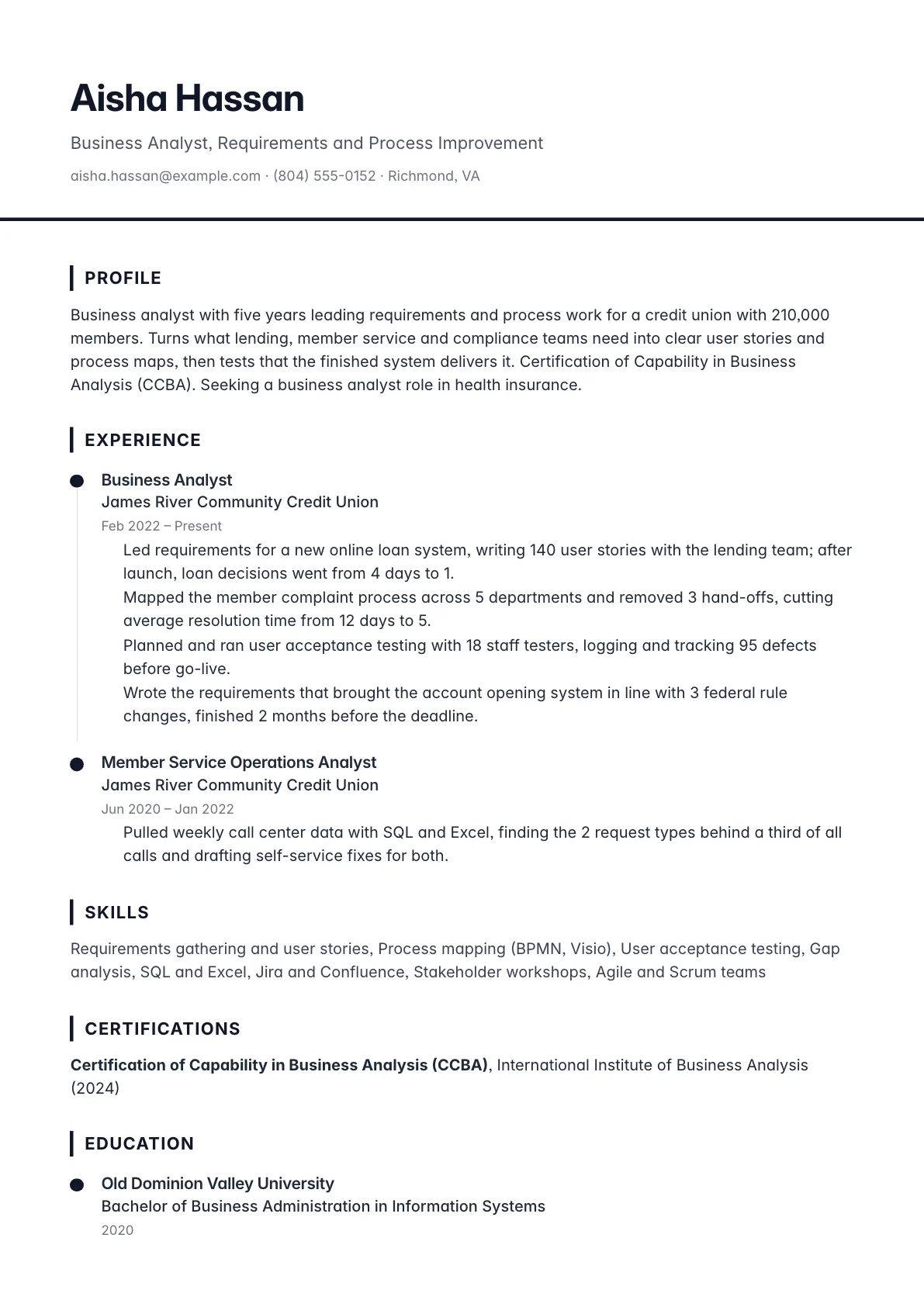
A business analyst with five years at a credit union applying for a business analyst role at a health insurance company.

Why this resume works

  • Each bullet names the project, the analyst's own contribution and the business result, such as loan decisions cut from 4 days to 1 after the new system went live.
  • The tools and methods (user stories, process maps, SQL, Jira) sit inside the bullets, showing how she works rather than only listing it.
  • The CCBA certification and the compliance project for 3 federal rule changes signal she can handle the regulated, detail-heavy work a health insurer needs.
Edit & download this resume

Edit it in the free builder, then download the PDF with no watermark. A free account is only needed to download.

A business analyst stands between the people who run a business and the people who build its systems. You find out what a team really needs, write it down so clearly that developers can build it and testers can check it, and make sure the finished system solves the problem it was meant to. Because the job is mostly listening, writing and deciding, a business analyst resume can easily sound vague. The ones that get interviews name the systems, the teams, the documents you produced and what changed for the business when the project went live.

This guide covers what goes on a business analyst resume, how to turn requirements work into results with numbers, the skills and tools postings ask for (explained in plain words), summary and bullet examples by level, the IIBA and PMI certifications, and a full example for a credit union analyst applying to a health insurer. If your work is mostly reports and dashboards, the data analyst resume example may fit better.

Business analyst pay and job outlook

Official figures for Management Analysts.

Median pay (2025)
$101,860 per year ($48.97 per hour)
Jobs in 2025
1,077,100
Job outlook, 2025 to 2035
10%, much faster than average
Change in jobs, 2025 to 2035
+109,200
Typical entry-level education
Bachelor's degree
Work experience needed
Less than 5 years

Business analyst is not a separate official occupation. These figures are for Management Analysts, a wider group that also includes management consultants; O*NET lists Business Analyst as a reported job title for it.

Sources: U.S. Bureau of Labor Statistics, Occupational Outlook Handbook: Management Analysts, checked September 2026; O*NET OnLine: Management Analysts, checked September 2026.

How to write a business analyst resume

1

Pick a headline that matches the posting's kind of analyst

Business analyst titles vary: IT business analyst, business systems analyst, process analyst, product analyst. Use the posting's term and add your strength, for example Business Analyst, Requirements and Process Improvement. It helps the recruiter file you correctly on the first read.

2

Write a summary with industry, scale and method

Three sentences: your years, the kind of organization and its size, then how you work (requirements, process maps, testing) and who you work with, then a certification if you have one and the role you want. Industry knowledge matters a lot in this job, so name yours and the one you are aiming for.

3

Show your part of each project, then the result

Business analysts work on team projects, so every bullet should make your own contribution clear: led requirements, mapped the process, ran testing. Then give the result the business saw after launch: faster decisions, fewer errors, less manual work, a deadline met, money saved. If the project is still running, give a milestone reached.

4

Name the documents and methods you use

Readers want to know what you actually produce. Mention user stories (short descriptions of a feature from the user's point of view), acceptance criteria (the checks that prove it works), process maps, requirements documents and test plans. Add the number where you can: 140 user stories shows the size of the work.

5

Include testing and change work

Many analysts also run user acceptance testing (UAT), the stage where real staff try a new system before launch, and help teams adopt it with training and guides. These show you follow a project to the end, which hiring managers value. Give the number of testers, defects found or people trained.

6

Finish with skills, certifications and education

List eight to twelve skills, mixing methods (requirements, process mapping, gap analysis) and tools (Jira, Confluence, Visio, SQL, Excel). Add an IIBA or PMI certification with its year, then your degree. Keep it to one page unless you have ten or more years or many large projects.

Skills and keywords for a business analyst resume

These skills and tools come up again and again in business analyst postings. Use the ones you have, in the posting's words.

Hard skills

  • Requirements gathering: interviews, workshops and observation
  • Writing user stories and acceptance criteria
  • Process mapping, including BPMN (a standard way to draw business processes)
  • Gap analysis: comparing how things work now with how they should work
  • User acceptance testing (UAT) planning and coordination
  • Data analysis with SQL and Excel
  • Business cases and cost-benefit analysis
  • Working in agile and Scrum teams, including backlog grooming
  • Wireframes and simple screen mockups
  • Understanding industry rules (banking, healthcare, insurance)

Soft skills

  • Asking questions that uncover the real need
  • Leading workshops with people who disagree
  • Clear, precise writing
  • Explaining technical limits to business teams and business needs to developers
  • Keeping many people aligned on scope
  • Patience with detail and follow-through

Tools and software

  • Jira and Confluence
  • Microsoft Visio or Lucidchart
  • Excel and SQL
  • Power BI or Tableau for simple reports
  • Figma or Balsamiq for mockups
  • Azure DevOps

Business analyst resume summary examples

Pick the one closest to you and change the details. Each gives your industry, how you work, a result and the job you want.

Entry-level business analyst

Business administration graduate with a six-month analyst internship at a hospital, where I mapped the patient discharge process and wrote requirements for a new discharge checklist used on 4 units. Skilled in Excel, Visio and interviewing staff, and completing the IIBA Entry Certificate in Business Analysis. Seeking a junior business analyst role in healthcare or insurance.

Experienced business analyst

IT business analyst with six years in retail, gathering requirements for point-of-sale, inventory and online ordering systems used in 300 stores. Write user stories and acceptance criteria for two Scrum teams and lead testing for every release. Seeking a business analyst role on a larger digital commerce program.

Senior business analyst

Senior business analyst with eleven years in insurance, leading a team of four analysts on the replacement of the company's claims system. Set the requirements and testing approach for a program of 60 people and wrote the business case that secured its funding. CBAP; seeking a lead analyst or business architecture role.

Business analyst resume bullet examples

Each bullet shows your part, the method and the result, with a number. Keep the shape and use your own facts.

  • Ran 12 workshops with claims, finance and IT to agree requirements for a new billing system, signed off 3 weeks early.
  • Wrote 220 user stories with acceptance criteria for a mobile banking app, with fewer than 5 percent sent back for rework.
  • Mapped the vendor onboarding process and removed 4 approval steps, cutting setup time from 21 days to 8.
  • Coordinated user acceptance testing with 30 testers across 3 states, finding 120 defects before launch.
  • Built the business case for an automated invoice tool, projecting $450,000 in yearly savings; it was approved and delivered.
  • Analyzed 2 years of service requests in SQL and found that 35 percent were password resets, leading to a self-service reset tool.
  • Documented 45 current processes for a system migration, giving the vendor a complete picture before design.
  • Trained 150 staff on the new scheduling system with short guides and 10 live sessions.
  • Acted as the product owner's backup for a Scrum team of 7, keeping the backlog ready 2 sprints ahead.
  • Traced 80 regulatory requirements to test cases, passing the external audit with no findings.
  • Reduced change requests after launch by 40 percent by adding screen mockups to requirements reviews.

Certifications for business analysts

No license is required to work as a business analyst. Certifications are optional, but some postings list them as preferred, especially in banking, insurance, healthcare and government. The main certifying bodies are the International Institute of Business Analysis (IIBA) and the Project Management Institute (PMI). Requirements below are as of September 2026:

  • Entry Certificate in Business Analysis (ECBA) from IIBA: the starting-level IIBA certification for people new to business analysis.
  • Certification of Capability in Business Analysis (CCBA) from IIBA: asks for 3,750 hours of business analysis work in the last seven years and 21 hours of professional development in the last four, plus two references.
  • Certified Business Analysis Professional (CBAP) from IIBA: for experienced analysts, asking for 7,500 hours of business analysis work in the last ten years and 35 hours of professional development in the last four. IIBA says it must be renewed every three years.
  • PMI Professional in Business Analysis (PMI-PBA) from the Project Management Institute: a business analysis certification from PMI, common in organizations that already use PMI project management standards.

The example, line by line

The example is for Aisha, a business analyst at a credit union who wants to move to a health insurer. Here is what each part does.

Headline: Business Analyst, Requirements and Process Improvement. These are the two halves of most business analyst postings, so she matches both.

Summary: five years and the size of the organization (210,000 members), then how she works and with which teams, then her CCBA and the industry she wants. Moving from banking to insurance is a natural step, because both are regulated and she says so through the compliance work below.

Experience: four bullets for her current role, each showing her part and the result. She wrote 140 user stories and loan decisions dropped from 4 days to 1. She mapped a process across 5 departments and complaints were resolved in 5 days instead of 12. She ran testing with 18 staff and caught 95 defects. She handled 3 federal rule changes and finished 2 months early. Her earlier operations analyst role keeps one bullet that shows SQL and Excel skills and a habit of finding causes.

Skills, certification and education: eight skills mixing methods and tools, the CCBA from 2024, then her business degree in information systems from 2020.

Mistakes that cost business analysts interviews

  • Vague verbs. Liaised with stakeholders and facilitated communication could describe anyone. Say what you produced: requirements, process maps, test plans, and how many.
  • No result after go-live. The project launching is not the result. What got faster, cheaper or more accurate afterward?
  • Taking credit for the whole project. Managers know analysts work in teams. Be clear about your part; it reads as more credible, not less.
  • Hiding your industry. Business analysis depends on knowing the business. Name the industry and the kinds of systems, such as loans, claims or billing.
  • A tool list with no methods. Jira and Visio are tools; requirements and process analysis are the job. List both, and show the methods in your bullets.
  • Confusing the title with project management. If you mostly managed schedules and budgets, the project manager guide may fit better. If you did both, say which parts were analysis.

Other resume examples close to this one:

Every example is in the resume examples hub, grouped by job and situation.

Build it free, no watermark

CVPoet's resume builder is free to use without an account. Start from this example or a blank page, pick one of four ATS-friendly designs, and download a PDF with no watermark on any plan.

Frequently asked questions

What should a business analyst put on a resume?

Contact details, a headline matching the posting's kind of analyst, a short summary, your experience with your part in each project and the result, a skills section mixing methods and tools, any IIBA or PMI certification, and your education.

What skills are most important for a business analyst?

Requirements gathering, user stories and acceptance criteria, process mapping, testing, and clear writing. Tools such as Jira, Confluence, Visio and Excel are common, and SQL is a plus in many postings.

How do I write a business analyst resume with no experience?

Show analysis you have already done in other jobs: fixing a process, gathering what a team needed for a new tool, testing a system rollout, building a tracking spreadsheet. Write each like a project with a result, and consider the IIBA ECBA.

Is the CBAP or CCBA worth getting?

They are optional, but they are well known in banking, insurance, healthcare and government, where postings sometimes list them as preferred. CCBA fits analysts with a few years of experience; CBAP is for experienced analysts.

How do I show results as a business analyst?

Measure what changed after your project went live: time saved, errors reduced, faster decisions, lower costs, deadlines met, audits passed. If you cannot measure it, name the decision your analysis supported.

What is the difference between a business analyst and a data analyst?

A business analyst works on processes and requirements for new or changed systems. A data analyst answers questions with data and reports. Many jobs overlap, so describe the parts of each that you do.

Should I list agile experience?

Yes, if you have worked on Scrum or other agile teams. Many analyst roles now write user stories and help manage a backlog. Mention the team size and your part, such as keeping the backlog ready two sprints ahead.

How long should a business analyst resume be?

One page for most analysts. Senior analysts with ten or more years and many large programs can use two, with the most recent and relevant work first.

Do business analysts need technical skills?

Not deep programming, but postings often ask for SQL, Excel and an understanding of how systems and data fit together. IT business analyst and business systems analyst roles expect more technical depth.

What title should I use if my job had a different name?

Use your real title, and let the headline and summary say business analyst if that is the work you did. For example, an operations analyst who wrote requirements can show that in the bullets.

Build your business analyst resume now

Start from Aisha's example or a blank page. Free, no account needed, and the PDF has no watermark.

Build your resume, free
Business analyst resume example
Business analyst resume example The example above as an image, to save or share. To change it, use Edit & download this resume at the top of the page. Open the full-size image