Graduate School Resume: Examples (2026)

How to write a resume for a graduate school application: research, publications, test scores and how it differs from an academic CV, plus a free template.

Template:

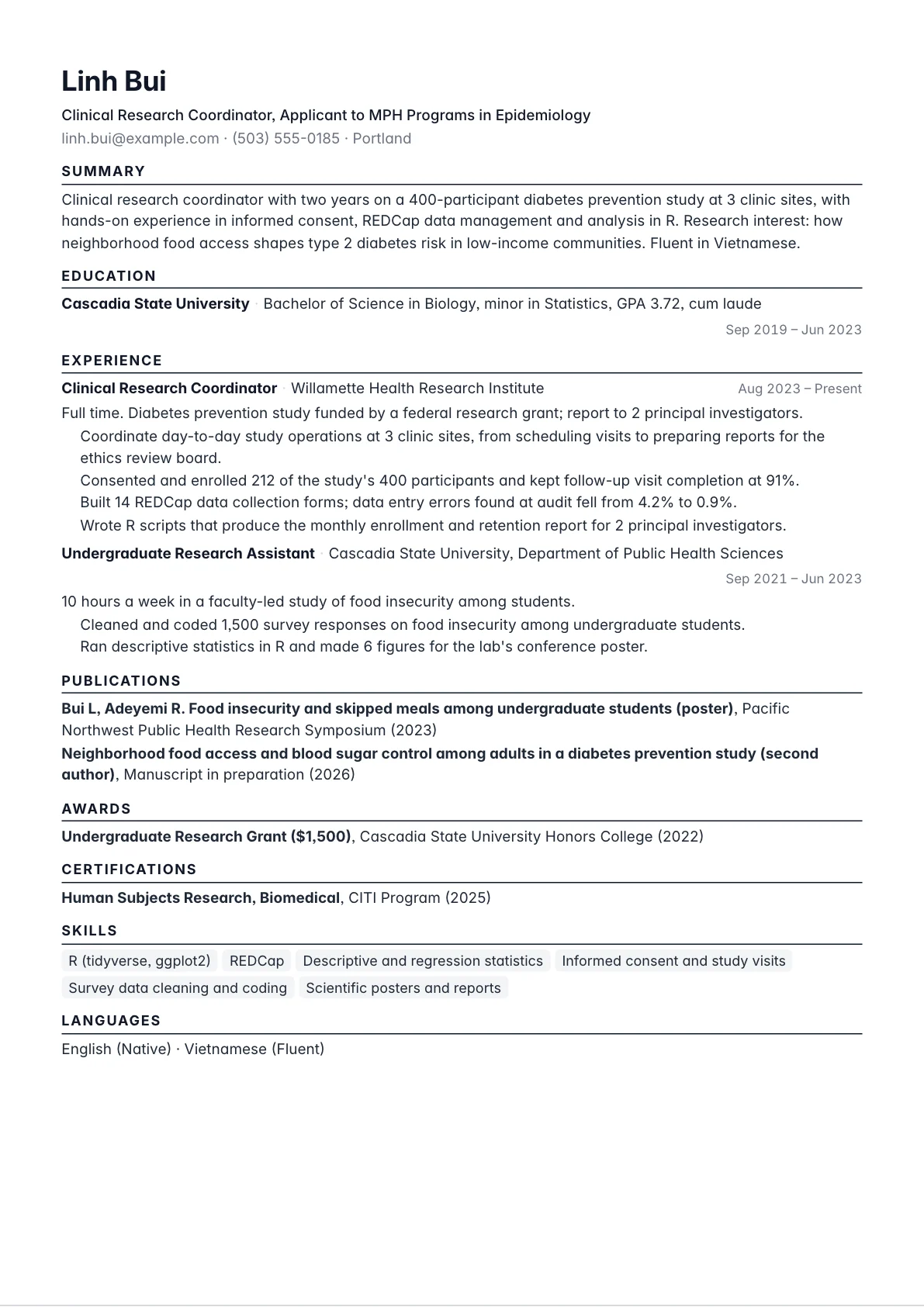
A clinical research coordinator with a biology degree and two years of study experience applying to Master of Public Health programs in epidemiology for fall 2027.

Why this resume works

  • Education comes first, with the GPA of 3.72 and the statistics minor in plain view, because the committee judges academic readiness before anything else.
  • Research bullets say exactly what her role was and how big the study is: 212 of 400 participants enrolled, 14 data forms built, audit errors cut from 4.2% to 0.9%.
  • The poster and the manuscript are labeled honestly (presented, in preparation), and the manuscript's topic matches the research interest in her summary.
Edit & download this resume

Edit it in the free builder, then download the PDF with no watermark. A free account is only needed to download.

A graduate school resume is read by faculty, not recruiters. An admissions committee wants to know whether you can do advanced work in their field: what you studied and how well, what research or professional work you have done and what your part in it was, what you have presented or published, and whether the interests in your statement of purpose show up in what you have actually done. A job-search resume built around sales targets or shift counts answers the wrong questions.

This guide covers what each program may ask for (a resume, a CV, test scores), how to order the sections, how to write research experience honestly, how to list posters and papers, when test scores belong, how a graduate school resume differs from an academic CV, and a complete example for a clinical research coordinator applying to Master of Public Health programs. Still an undergraduate looking for research or campus work? The college student resume guide is the better start.

How to write a resume for graduate school

1

Check exactly what each program asks for

Read every program's application instructions before you write. Note whether it asks for a resume or a CV, any page limit, which sections it wants to see, and whether test scores are required, optional or not considered. Programs differ, and following each one's instructions is the first thing a committee notices.

2

Lead with education, in detail

Put your degree, school, major and minor, dates and GPA at the top. Add honors, a thesis or capstone title, and two or three advanced courses when they connect to the program. If you have taken classes since graduating (a statistics course, a prerequisite for the program), list them here too.

3

Describe research by your role, method and scale

For each research or lab position, name the lab or study, the principal investigator's field, your title, dates and hours. Then say what you did in plain terms: enrolled participants, cleaned data, ran analyses, built forms, wrote methods sections. Give the scale (sample size, sites, number of samples) and say honestly which parts were yours.

4

List posters, talks and papers in citation style

Use a consistent format: authors, title, where it was presented or published, and year. Label the status truthfully: published, accepted, under review, in preparation. Posters and talks count, including at student and regional conferences.

5

Add test scores only when a program asks

If a program requires or recommends the GRE, a short line works: GRE General Test (August 2026): Verbal 162, Quantitative 158, Analytical Writing 4.5. ETS scores the Verbal and Quantitative sections from 130 to 170 and Analytical Writing from 0 to 6, and scores stay reportable for 5 years after your test date. The resume line never replaces the official score report sent from ETS. If a program does not ask, leave scores off.

6

Make it agree with your statement of purpose

The research interest you write about in your statement should appear in the resume as something you have done or started. Add skills the program uses (a statistics language, a lab technique, a survey tool), and keep work outside your field to one or two lines that show responsibility.

Graduate school resume or academic CV?

The two documents overlap, but they are built for different readers.

  • Graduate school resume: one to two pages, selective, and shaped for one application. It includes relevant jobs alongside research, and leaves out anything that does not help the committee judge you.
  • Academic CV: a complete record of an academic career, with no page limit. It lists every publication, presentation, grant, teaching role and service role, and grows over time. PhD applicants with substantial research sometimes send a CV-style document; faculty candidates always do.

If a program says resume or CV, a one- to two-page document in resume style with research and publication sections is the safe choice for most master's applicants. If it asks for a CV specifically, include every academic item, even small ones.

A good order for most applicants: education, research experience, publications and presentations, relevant work, honors and grants, certifications and training, then skills and languages. People with several years of professional work in the field can put that work before research. Use one clean column so the committee can scan it; the Compact template fits a research record on one page without looking crowded.

The example, line by line

The example is for Linh, who finished a biology degree in 2023 and has worked as a clinical research coordinator since. She is applying to Master of Public Health programs in epidemiology.

Headline and summary: her current role and her target in one line, then two sentences: the study she runs (400 participants, 3 sites) and the methods she uses, followed by a one-sentence research interest. The committee sees what she wants to study before it reads a single bullet.

Education: first, with the statistics minor, a 3.72 GPA and cum laude on the same line, because those are the facts that predict success in an epidemiology program's quantitative courses.

Clinical Research Coordinator: the summary line says who she reports to (2 principal investigators). The bullets give her part of the study precisely: 212 participants enrolled, 91% follow-up, 14 data forms with errors down from 4.2% to 0.9%, and R reporting.

Undergraduate Research Assistant: 10 hours a week, 1,500 survey responses coded and 6 figures made. This is where her food access interest started.

Publications: a 2023 poster and a 2026 manuscript marked in preparation, with her author position stated. Nothing is dressed up as published.

Award, training, skills and languages: a $1,500 research grant, human subjects research training from the CITI Program, skills named as tools (R, REDCap), and Vietnamese, useful for community research. No GRE line, because her programs do not ask for one.

Mistakes that weaken a graduate school resume

  • Sending your job-search resume unchanged. A resume built to get a sales or office job buries the research, coursework and methods a committee reads for.
  • Overstating your research role. Conducted a study when you entered data will come out in your recommendation letters. Say what you did; real tasks described precisely are impressive at this stage.
  • Loose publication status. Listing a draft as submitted or a poster as a paper is easy to check and hard to explain. Use the exact status.
  • Test scores nobody asked for. If a program does not consider the GRE, the line takes space and can distract. Include scores only where they are requested or recommended.
  • Every course you ever took. A long course list reads like a transcript, which the committee already has. Name two or three advanced courses that matter.
  • A resume that contradicts your statement. If your statement says you want to study neuroscience and nothing on the page touches it, explain the link, or add the class, project or volunteer work that does.

These guides cover the steps around a graduate application:

Every example is in the resume examples hub, grouped by job and situation.

Build it free, no watermark

CVPoet's resume builder is free to use without an account. Start from this example or a blank page, pick one of four ATS-friendly designs, and download a PDF with no watermark on any plan.

Frequently asked questions

Do I need a resume for graduate school?

Most programs ask for a resume or CV as part of the application. Check each program's instructions for what it wants and any page limit.

What should a graduate school resume include?

Education with GPA and honors, research experience, publications and presentations, relevant work, awards and grants, certifications and training, and skills. Add test scores only if the program asks for them.

Is a graduate school resume the same as a CV?

No. A resume is one to two pages and selective. A CV is a complete academic record with no page limit. Send what the program asks for; if it accepts either, a research-focused resume suits most master's applicants.

How long should a graduate school resume be?

One page for most applicants coming straight from a bachelor's degree, two pages if you have several years of research or professional work.

Should I put my GRE scores on my resume?

Only when the program requires or recommends the GRE. Report the section scores and test date, and have ETS send the official report as well.

Should education come first on a graduate school resume?

Usually yes, because the committee is judging academic readiness. Applicants with long professional careers in the field can put that experience first.

How do I list research experience if I was not an author?

As a position, with the lab or study, your title, dates and hours, and bullets for what you did. Authorship is not needed for research experience to count.

How do I list a paper that is not published yet?

Give the authors, title and status: under review, accepted or in preparation. Never list a paper as published or accepted before it is.

Should I include jobs outside my field?

Keep one or two lines for jobs that show responsibility, especially long-held ones. Committees like to see that you can manage work and study, but the research record comes first.

Should my resume match my statement of purpose?

Yes. The interests and experiences in your statement should appear on the resume, and the dates, titles and names should be identical in both.

Build your graduate school resume

Start from Linh's research resume or a blank page, and download a clean PDF for your applications. Free, no watermark.

Build your resume, free
Graduate school resume example
Graduate school resume example The example above as an image, to save or share. To change it, use Edit & download this resume at the top of the page. Open the full-size image