Scholarship Resume: Examples and Tips (2026)

How to write a scholarship resume: what selection committees score, the sections to include, a full example for a high school senior, and a free template.

Template:

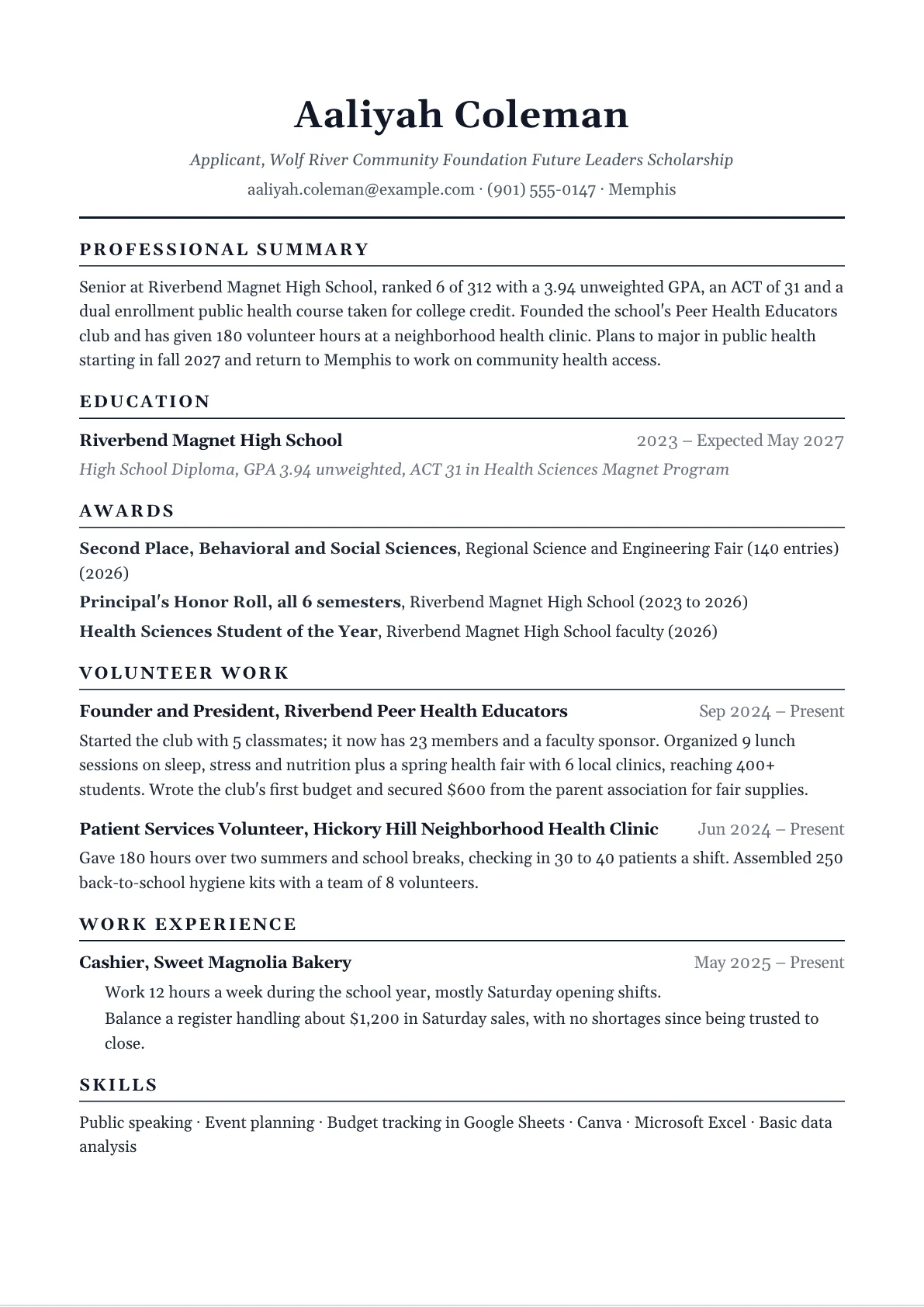
A high school senior applying for a community foundation's Future Leaders Scholarship, which scores academics, service and leadership.

Why this resume works

  • The headline names the exact award, and the three sections that follow (education, honors, service) mirror the three things the foundation says it scores.
  • Service and leadership carry hard numbers a reviewer can compare across applicants: 180 clinic hours, a club grown from 5 to 23 members, 400+ students reached.
  • The bakery job stays, because working 12 hours a week while holding a 3.94 GPA says more about her discipline than any adjective could.
Edit & download this resume

Edit it in the free builder, then download the PDF with no watermark. A free account is only needed to download.

A scholarship resume has a different reader from a job resume. Nobody on a selection committee is asking whether you can run a register or show up for a shift. They are scoring you against the criteria printed in the scholarship's own description: grades and course rigor, service to the community, leadership, and sometimes a planned major, a hometown or a cause the donor cares about. The resume is your evidence file. It lets a volunteer reviewer with a stack of applications check each criterion in under a minute, then read your essay knowing the facts are already there.

This guide shows how to read a scholarship's criteria and build the resume around them, which sections to put first for merit, service and major-specific awards, how to write hours and honors so they carry weight, and a complete example for a senior applying to a community foundation's leadership award. It also covers the thing that surprises many students: financial need does not belong on the resume at all. If you are applying for a job rather than an award, the high school student resume guide is the better fit.

How to write a scholarship resume

1

Turn the scholarship's criteria into a checklist

Open the award's description and copy out every quality it names: academic achievement, community service, leadership, interest in a field, ties to a county or group. Those words are close to the scoring rubric the committee uses. Every section of your resume should answer one of them, and anything that answers none of them is a candidate for cutting.

2

Put the award's name in your headline

Under your name and contact details, write a line such as Applicant, Hometown Service Scholarship or Future Nursing Student, County Health Foundation Award. A reviewer reading forty files can see at a glance that this resume was built for this award and not pasted in from somewhere else.

3

Open with academics, with the numbers that count

Your school, expected graduation, GPA (say whether it is weighted or unweighted), class rank if your school reports it, and ACT or SAT scores if they help. Then name the hardest courses you took that connect to your plans (AP, IB, honors or dual enrollment classes that earned college credit) in your summary, where a reviewer reads them first. College students applying for scholarships give their major, GPA and expected graduation instead.

4

Give every honor its size and level

An award means little to a stranger unless they know how hard it was to win. Add the level (school, district, regional, state, national) and, when you know it, the size of the field: Second Place, Regional Science Fair, 140 entries. Put the most selective honors first, not the most recent.

5

Write service and leadership with hours and outcomes

Committees for service and leadership awards look for depth over a long list. For each activity give your role, the dates, your total hours, and one or two lines about what changed because you were there: members recruited, money raised, people served, a program you started. Keep hour totals honest; the same coordinator may be asked to confirm them in a recommendation.

6

Finish with work, skills, and a last check against the essay

Paid jobs show responsibility, especially when you hold them during the school year. Add a short skills line (languages, software, certifications). Then read your resume next to your essay and recommendation letters. They should support each other: the essay tells one story in depth, the resume shows the full record, and nothing in one contradicts the other.

Which sections go first on a scholarship resume?

Let the type of award decide the order. The sections are mostly the same; what changes is which one the reviewer meets first.

  • Merit and academic awards: education, then honors and awards, then activities. Test scores and course rigor matter most here.
  • Service awards: education in brief, then volunteering with hours, then leadership. Some service scholarships set a minimum number of hours, so put your total where it is easy to find.
  • Leadership awards: a leadership section with the offices you held and what you did in them, then education, then service.
  • Awards tied to a field (nursing, engineering, teaching): education with related courses, then any research, projects, job shadowing or work in that field, then everything else.
  • Athletic scholarships: college recruiting uses a separate athletic profile; the student athlete resume guide covers both versions.

Where financial need goes. Not on the resume. Need-based awards measure need through their own forms, or through the Free Application for Federal Student Aid (FAFSA), which colleges and some states also use to decide their own grants and scholarships. If a hardship shaped your record, such as working to support your family, the essay is the place to explain it. On the resume, the job itself (with its hours) speaks for you.

Keep it to one page and send a PDF unless the portal asks for something else. Many application portals also have fields for activities; fill them in fully even when you upload a resume, and copy your dates and hours from the resume so the two match exactly.

The example, line by line

The example is for Aaliyah, a senior in Memphis applying for a local foundation's Future Leaders Scholarship. The foundation says it scores academics, service and leadership, so her page is built in that order.

Headline: it names the foundation and the award. That line costs nothing and shows the reviewer she read their criteria.

Summary: one sentence per criterion, plus her plan. Rank 6 of 312, a 3.94 unweighted GPA, an ACT of 31 and a college-credit public health course cover academics and course rigor. The club she founded covers leadership. The 180 clinic hours cover service. The last line ties her planned public health major back to Memphis, which matters to a community foundation that wants its money to come home.

Education: the GPA and ACT score sit in the diploma line, where a reviewer looks for them, and the health sciences magnet program is named as her field because it explains her interest in health.

Honors: the science fair award names the field of 140 entries, so a reviewer can judge it. Honor roll for all 6 semesters shows consistency, and the faculty award shows teachers noticed her.

Service and leadership: the club entry grows from 5 founding members to 23, then gives reach (9 sessions, 6 clinics, 400+ students) and a budget line ($600 raised). The clinic entry gives hours and patients per shift, which are the two numbers a service committee compares.

Work and skills: 12 hours a week at a bakery during the school year, plus trust with the register. The skills are ones she used in the club and the job, not a list of adjectives.

Mistakes that cost scholarship applicants points

  • Writing about money on the resume. Family income, hardship and need belong in the need forms or the essay. On the resume they take space from the achievements the committee is actually scoring.
  • Sending the same resume to every award. A STEM scholarship and a service scholarship reward different things. Change the headline and the order of sections for each one; it takes ten minutes.
  • Honors with no context. Gold Award or Student of the Month means nothing to a reviewer from another town. Say who gave it, at what level, and how many people competed when you know.
  • Rounding hours up. A committee may compare your total with a coordinator's letter. Use the real figure, and if it is small, show depth instead: a role you took on or something you built.
  • Listing everything since sixth grade. Start from ninth grade (or from college, for college students). Keep an earlier activity only if it continued or led to something the committee will care about.
  • Copying the essay into the summary. The resume states facts in short lines; the essay tells the story. If they repeat each other, you lose half your space.

These guides cover situations close to yours:

Every example is in the resume examples hub, grouped by job and situation.

Build it free, no watermark

CVPoet's resume builder is free to use without an account. Start from this example or a blank page, pick one of four ATS-friendly designs, and download a PDF with no watermark on any plan.

Frequently asked questions

Do I need a resume for a scholarship application?

Only if the application asks for one or allows an upload, but it is worth having either way. It keeps your dates, hours and honors in one place, makes long application forms faster, and gives teachers writing your recommendation letters the facts they need.

What should a scholarship resume include?

Contact details, a headline naming the award, a short summary, education with GPA and challenging courses, honors and awards with their level, service and leadership with hours and results, work experience, and a few skills. Order the sections by what the scholarship scores.

Should I put my financial situation on a scholarship resume?

No. Need-based scholarships measure need through their own forms or through federal financial aid information, and some ask for an essay about your circumstances. The resume is for achievements, service, leadership and work.

How long should a scholarship resume be?

One page for high school students and nearly all undergraduates. A graduate student with research and publications may need two, but only if the award is academic and every line is relevant.

Should I include my GPA and test scores?

Include your GPA if it is a strength or if the award has a minimum, and say whether it is weighted or unweighted. Include ACT or SAT scores when they are strong for your target schools. Leave off a score that would not help you.

How do I list volunteer hours on a scholarship resume?

Give the total hours for each activity in its description, for example 180 hours over two summers, and keep the numbers you could confirm with the organization. If a scholarship has an hour minimum, add your overall total to your summary.

Can I use my college application resume for scholarships?

Yes, as a starting point. Then change the headline to name the scholarship, move the sections the award scores to the top, and cut activities that do not relate to it.

What if I do not have many awards?

Put more weight on service, leadership, work and family responsibilities, written with dates, hours and results. A long, steady commitment to one activity often impresses committees more than a list of small honors.

Should I include a job that has nothing to do with my major?

Yes. Working during the school year shows time management and responsibility, which almost every scholarship values. Keep it to one or two lines with your weekly hours.

What file format should I upload?

A PDF, unless the portal asks for a Word file. Name it with your name and the award, for example Aaliyah-Coleman-Future-Leaders-Resume.pdf, so a reviewer who downloads it can find it again.

Build your scholarship resume now

Start from Aaliyah's example or a blank page. It is free, needs no account, and the PDF has no watermark.

Build your resume, free
Scholarship resume example
Scholarship resume example The example above as an image, to save or share. To change it, use Edit & download this resume at the top of the page. Open the full-size image