Student Athlete Resume: Examples (2026)

How to write a student athlete resume for jobs and internships: turning your sport into work evidence, where athletics go, a full example and a free template.

Template:

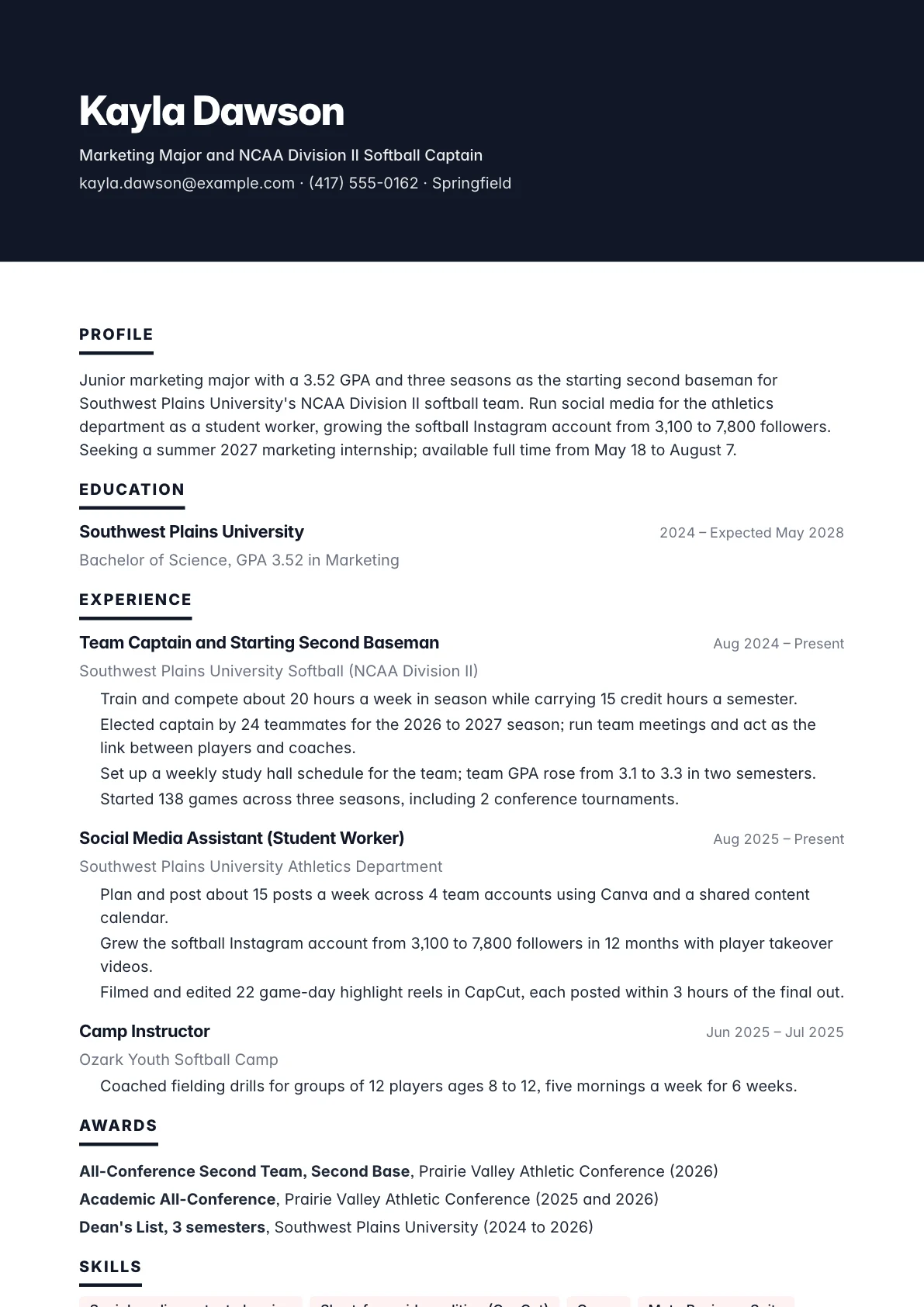
A college junior on an NCAA Division II softball team applying for a summer 2027 marketing internship at a regional bank.

Why this resume works

  • Softball is written as an experience entry with a title and results (captain elected by 24 teammates, team GPA up from 3.1 to 3.3), not as a hobby at the bottom.
  • The athletics social media job connects her sport to the internship she wants, with numbers a marketing manager recognizes: followers grown from 3,100 to 7,800 and 22 highlight reels.
  • Her availability (May 18 to August 7) is in the summary, which answers the first question an employer has about any in-season athlete.
Edit & download this resume

Edit it in the free builder, then download the PDF with no watermark. A free account is only needed to download.

If you play a sport at school, you already have more work experience than your resume probably shows. You have kept a schedule most adults would find hard: early practices, travel, film sessions and classes, all at once. You have taken feedback from coaches every day, worked inside a team with a clear chain of command, and performed with people watching. The problem is that Varsity Soccer, 4 years on the last line of a resume tells an employer none of that. The fix is to write your sport the way you would write a job.

This guide is for high school and college athletes applying for jobs and internships, and for recent athletes who have just stopped competing. It covers where athletics belong on the page, how to turn training and competition into lines an employer values, how to handle the limited availability that comes with a season, and a complete example for a college softball player applying for a summer marketing internship. If you are looking for a place to play rather than a job, the recruiting profile is a different document; the FAQ below explains the difference.

How to write a student athlete resume

1

Decide how big your sport should be on the page

If you compete in college, your sport is probably your biggest time commitment, and it belongs in the experience section as its own entry. If you played casually or quit early, one line under activities is enough. Recent graduates who have stopped competing can keep a college career as an entry for a year or two, then shrink it to one line.

2

Write the team as an entry with a title

Use the school and team as the organization, your level (NCAA Division I, II or III, NAIA, junior college, varsity) and a title: Team Captain, Starting Goalkeeper, Four-Year Letter Winner. Give the dates you were on the roster. That format tells a recruiter at a glance that this was a serious, structured commitment.

3

Translate training and competition into work evidence

Pick the parts an employer pays for and add a number to each: weekly hours in season next to your credit load (time management), a vote by teammates for captain (trust), a program you ran for the team (initiative), starts or minutes played (reliability). Skip statistics like batting average or points per game unless the job is in sports; to most employers they are not evidence of anything they need.

4

Show a real job or project next to the sport

Athletes are sometimes assumed to have done nothing but play. Any job, campus role, internship or class project breaks that assumption. A student worker job in the athletics department, a summer camp or a business class project with a real client all count. Put them in the same experience section, most relevant first.

5

Answer the availability question in advance

Employers who know athletes will wonder about your season. Put your available dates in the summary for internships, or your weekly hours for part-time work: available 15 hours a week, weekends included, in the off season. Being specific makes you easier to schedule than a non-athlete who says nothing.

6

Add honors that travel outside sport

Academic all-conference awards, scholar-athlete honors and captaincies mean something to any employer, because they combine performance with discipline. Athletic honors like all-conference teams can go in an awards section too. Finish with skills an employer can use from day one: software, languages, certifications such as first aid for coaching jobs.

Where do athletics go on a resume?

For most college athletes the order is: contact details and headline, a short summary with your availability, education, experience (sport and jobs together, most relevant first), awards, then skills. The sport sits in experience because it is the biggest thing you do; employers read that section first.

Two cases change it:

  • You have a job or internship in your target field. Put that entry above the sport. The sport stays, but the field experience leads.
  • You are in high school and applying for a first job. Put your team under activities, written the same way, next to clubs and volunteering. The high school student resume guide shows that layout.

Keep it to one page. If you played two sports, combine them into one entry with both teams in the title rather than giving each a full block. Leave off your height, weight and personal records on a job resume; they belong only on a recruiting profile.

Recruiting is a separate document. A coach recruiting you wants position, graduation year, measurables, statistics, GPA, video links and your current coach's contact details, usually on a one-page athletic profile. If you hope to compete at an NCAA school, the first step is an account with the NCAA Eligibility Center: students aiming for Division I or II register for a certification account, and Division III prospects create a profile page. When and how college coaches may contact you depends on your sport and division; the NCAA publishes those recruiting rules and calendars, so check them there or with your coach rather than in a resume guide.

The example, line by line

The example is for Kayla, a junior marketing major and softball captain applying for a summer marketing internship at a regional bank. Here is what each part does.

Headline: Marketing Major and NCAA Division II Softball Captain. It puts her field first and the sport second, which is the order the bank cares about.

Summary: major and 3.52 GPA, then three seasons as a starter, then the social media result, then the dates she can work. The bank's intern coordinator knows in four lines that she can do the work and when.

Education: her marketing major and 3.52 GPA in one line, with the expected graduation date, since a junior's major is still her main qualification.

Softball entry: written like a job. Twenty hours a week in season beside 15 credit hours shows the workload. The captaincy, voted by 24 teammates, shows trust. The study hall she organized, with team GPA rising from 3.1 to 3.3, shows initiative that has nothing to do with hitting. The 138 starts show she was dependable for three seasons.

Athletics department job: the most relevant entry for a marketing internship. It has output (about 15 posts a week on 4 accounts), a result (3,100 to 7,800 followers) and speed (22 reels, each up within 3 hours).

Camp job, awards and skills: one line of coaching shows she can teach kids ages 8 to 12. Academic all-conference is listed next to the athletic honor because it speaks to any employer, and the Dean's List for 3 semesters sits with them. The skills are the tools she uses every week.

Mistakes student athletes make on resumes

  • Burying the sport in one line. Twenty hours a week for three years deserves an entry with a title and results. Hiding it makes a busy, disciplined student look like one with little to show.
  • Filling the entry with game statistics. Earned run average and goals scored impress coaches, not hiring managers. Keep numbers that show workload, trust and initiative.
  • Using sports clichés. Team player who gives 110 percent says nothing. Show teamwork through what you did: a role you held, a program you ran, a teammate you trained.
  • Staying silent about your schedule. An employer who has to guess whether you can work in April may pick someone else. Give dates or weekly hours.
  • Sending the recruiting profile to an employer. Height, position statistics and highlight videos belong with coaches. A job resume leaves them off.
  • Dropping the sport entirely after graduation. For the first couple of years out of school, a college athletic career is still one of your strongest signals. Shorten it, but keep it.

These guides cover situations close to yours:

Every example is in the resume examples hub, grouped by job and situation.

Build it free, no watermark

CVPoet's resume builder is free to use without an account. Start from this example or a blank page, pick one of four ATS-friendly designs, and download a PDF with no watermark on any plan.

Frequently asked questions

Should I put sports on my resume?

Yes, if you compete seriously. A school or college team takes as much time as a part-time job and shows discipline, teamwork and the ability to take feedback. Write it with a title, dates and results, not just the name of the sport.

Where should I list athletics on my resume?

College athletes usually put their team in the experience section, next to jobs and internships. High school athletes applying for first jobs can use an activities section. Either way, write it like a job entry.

How do I describe being a student athlete on a resume?

Give your level, position or role, and the dates. Then add lines about weekly hours next to your course load, leadership roles such as captain, anything you organized for the team, and academic honors. Each line should start with an action and include a number.

Should I include my athletic statistics?

Not on a job resume, unless the job is in sports, such as coaching or athletics administration. For other employers, numbers about workload, starts, leadership and academic results say more.

What is the difference between an athletic resume and a job resume?

An athletic resume, or recruiting profile, is for coaches. It lists position, graduation year, height and other measurables, statistics, video links and coach contacts. A job resume is for employers and shows skills, experience and results they can use.

How do I explain limited availability during my season?

State it plainly and early: give your available dates for an internship or your weekly hours for part-time work, and mention the off season. Employers plan around schedules all the time; they just need to know yours.

I stopped playing after an injury. Should I still list my sport?

Yes, for the seasons you played. List the dates you were on the roster and what you did. If you stayed with the team in another role, such as student assistant, add it; it shows commitment.

Do walk-ons or practice players list athletics?

Yes. The hours, the training schedule and the team role are the same. Use a title that is accurate, such as Roster Member, and write about what you contributed.

How should a former college athlete write a resume for a first full-time job?

Keep the team as an experience entry for the first year or two, with two or three lines about leadership and workload. Lead with internships or jobs in your field, and use academic all-conference or scholar-athlete honors in an awards section.

Do I need to register with the NCAA to apply for jobs?

No. NCAA Eligibility Center registration is for high school students who want to compete at NCAA schools. It has nothing to do with job or internship applications.

Build your student athlete resume now

Start from Kayla's example or a blank page. Free, no account needed, and the PDF has no watermark.

Build your resume, free
Student athlete resume example
Student athlete resume example The example above as an image, to save or share. To change it, use Edit & download this resume at the top of the page. Open the full-size image