Pharmacist Resume: Examples and Tips (2026)

Pharmacist resume example with summaries, bullets and skills for retail, hospital and clinical roles, plus how to list your license and NAPLEX. Free template.

Template:

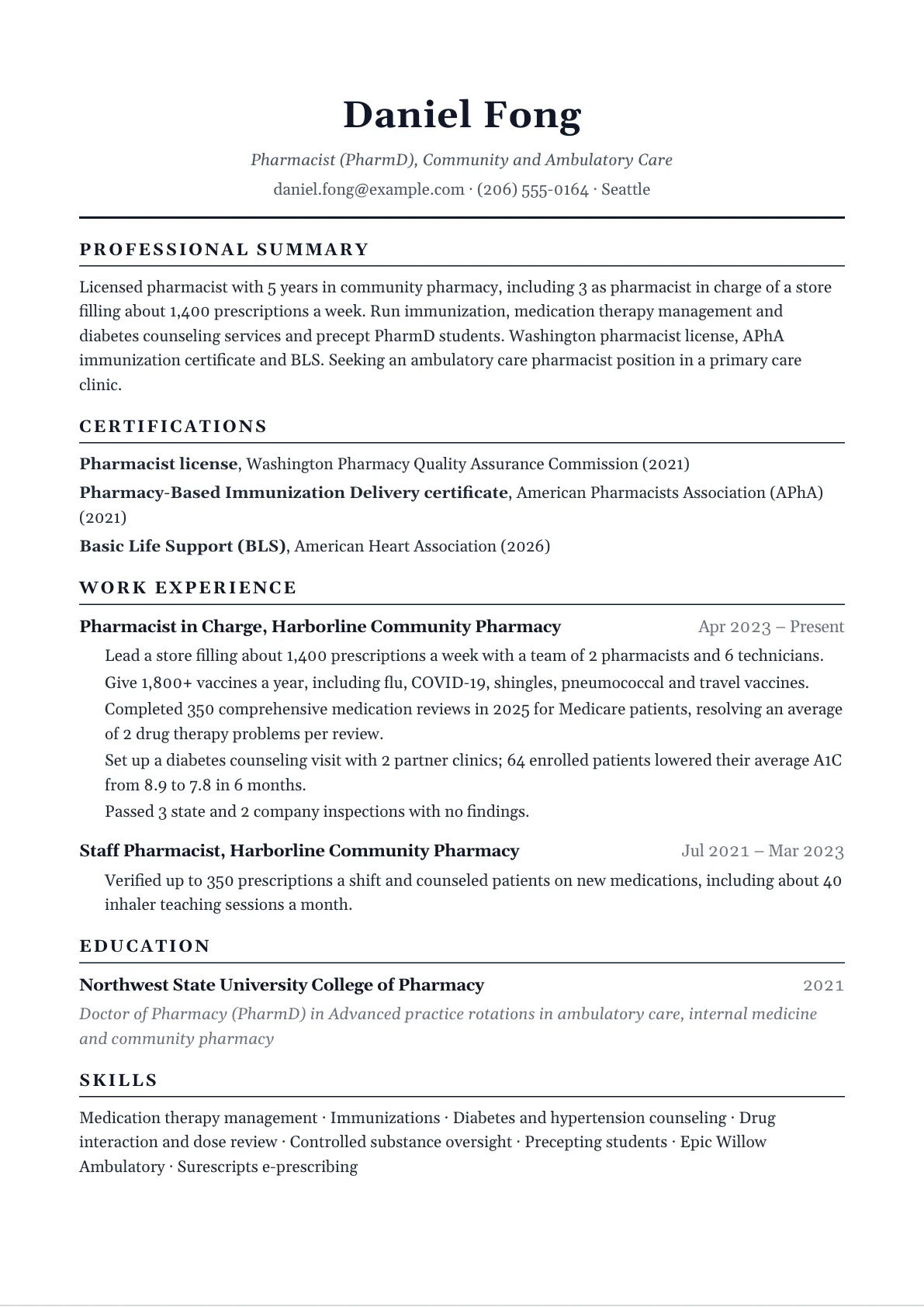
A community pharmacist and pharmacist in charge with five years of experience applying for an ambulatory care pharmacist job in a health system's primary care clinics.

Why this resume works

  • The summary leads with the clinical services he already runs, not the fill count, because an ambulatory care manager is hiring for patient care.
  • The diabetes bullet is the bridge to clinic work: 64 patients from 2 partner clinics, with average A1C falling from 8.9 to 7.8 in 6 months.
  • Leadership is shown with facts a health system trusts, a team of 2 pharmacists and 6 technicians and 5 inspections with no findings.
Edit & download this resume

Edit it in the free builder, then download the PDF with no watermark. A free account is only needed to download.

Pharmacist hiring managers read resumes for scope. Anyone with a license can verify prescriptions; what they want to know is how much you are trusted with. Do you run a store as pharmacist in charge? Do you dose vancomycin and heparin on your own protocols? Do you give vaccines, run medication reviews, or work in clinics alongside physicians? The answers, with the volume and results behind them, are what make one PharmD resume stand out from a stack of identical ones.

This page covers a full example for a community pharmacist moving into ambulatory care, how to order your resume, summary lines for new graduates, experienced pharmacists and pharmacy leaders, bullet examples for retail, hospital and clinic work, the skills postings mention, and the degree, exams and license you need, checked against the bodies that run them. Hiring your team? The pharmacy technician resume example is the companion page.

Pharmacist pay and job outlook

Official figures for Pharmacists.

Median pay (2025)
$140,910 per year ($67.75 per hour)
Jobs in 2025
325,200
Job outlook, 2025 to 2035
5%, faster than average
Change in jobs, 2025 to 2035
+17,100
Typical entry-level education
Doctoral or professional degree

Sources: U.S. Bureau of Labor Statistics, Occupational Outlook Handbook: Pharmacists, checked September 2026; O*NET OnLine: Pharmacists, checked September 2026.

How to write a pharmacist resume

1

Headline your degree and practice setting

Under your name, write PharmD and the setting you work in or want, such as Clinical Pharmacist, Internal Medicine, Pharmacist in Charge, Community Pharmacy or Ambulatory Care Pharmacist. Retail, hospital and clinic hiring managers each look for their own world first.

2

Put the license and certificates right after the summary

List your pharmacist license with the state board or commission that issued it, then certificates such as immunization training, BLS or ACLS, and any board certification you hold. If you are licensed in more than one state, list each state.

3

Write a summary about scope, not just volume

Years in practice and setting first, then the services you run (immunizations, medication reviews, anticoagulation, pharmacokinetic dosing), your leadership role if you have one, and the job you want. Keep prescription counts for the bullets.

4

Show clinical work with outcomes

For each job, pair what you do with a number: prescriptions verified, vaccines given, medication reviews completed, patients enrolled in a service, interventions accepted by prescribers, cost savings from formulary work, or lab values that improved. Hospital pharmacists can add order verification volume and the protocols they dose independently.

5

Give leadership its own facts

Pharmacist in charge, residency preceptor, committee member: say how many staff, how many students, what you changed and how inspections went. Health systems and chains both read these as signs you can be trusted with more.

6

Finish with education, rotations and residency

Your PharmD with the school and year, then any residency (PGY1, PGY2) with the site and focus. New graduates add advanced practice rotations that match the job. Keep it to one page early in your career and two pages later.

Skills and keywords for a pharmacist resume

Pharmacist postings share a core of dispensing and counseling skills and add clinical or leadership skills by setting. Use the posting's words where they are true for you.

Hard skills

  • Prescription and medication order verification
  • Drug interaction, allergy and dose checks
  • Patient counseling
  • Immunization administration
  • Medication therapy management (MTM)
  • Pharmacokinetic dosing (vancomycin, aminoglycosides)
  • Anticoagulation management
  • Sterile and nonsterile compounding oversight
  • Controlled substance inventory and records
  • Formulary and prior authorization work

Soft skills

  • Explaining medications in plain words
  • Tactful communication with prescribers
  • Calm under a heavy queue
  • Leading and coaching technicians
  • Careful, consistent checking
  • Teaching students and residents

Tools and software

  • Epic Willow, Oracle Health or MEDITECH pharmacy modules
  • Pharmacy dispensing systems and e-prescribing
  • State prescription drug monitoring programs (PDMP)
  • Automated dispensing cabinets (Pyxis, Omnicell)
  • Lexicomp, Micromedex or Clinical Pharmacology
  • Robotic and automated filling systems

Pharmacist resume summary examples

Pick the version that matches you and put in your own setting, services and license. Each one tells the reader how far your practice goes.

New graduate pharmacist

PharmD graduate with advanced practice rotations in internal medicine, ambulatory care and community pharmacy, plus 3 years as a pharmacy intern filling and counseling in a high-volume store. Passed the NAPLEX in 2026 and licensed by the state board of pharmacy; certified to immunize. Seeking a PGY1 residency or a staff pharmacist role with clinical responsibilities.

Experienced pharmacist

Hospital pharmacist with 7 years in a 400-bed medical center, verifying about 900 orders a shift and dosing vancomycin, aminoglycosides and heparin under pharmacy protocols. Rounds with the internal medicine team twice a week and precepts pharmacy students on acute care rotations. Seeking a clinical pharmacist position in internal medicine or critical care.

Senior pharmacist or pharmacy manager

Pharmacy manager with 14 years in hospital practice, leading 22 pharmacists and technicians across inpatient and outpatient pharmacies. Led the formulary work that saved $1.2 million a year and the switch to IV workflow software with no dispensing errors in the first year. Seeking a director of pharmacy position.

Pharmacist resume bullet examples

Pharmacist bullets are strongest when they show judgment as well as speed. Use these as patterns and fill in your own numbers.

  • Verify 700 to 900 medication orders per shift for a 350-bed hospital, flagging an average of 15 dosing or interaction issues a day.
  • Dose vancomycin and aminoglycosides for 20+ patients a day under the pharmacy protocol, keeping levels in range for 88 percent of patients.
  • Run an anticoagulation clinic for 280 warfarin patients, with 71 percent of INR results in range.
  • Reduced IV-to-oral conversion time by 1.5 days on average by adding a daily pharmacist review for eligible antibiotics.
  • Counsel 60+ patients a day on new prescriptions, including inhaler, insulin pen and injectable technique.
  • Cut prescription wait times from 34 to 18 minutes by rebuilding the store's workflow with technicians.
  • Gave 2,200 vaccines during one flu season, the highest total in a 40-store district.
  • Secured $180,000 a year in savings by moving 3 high-cost drug classes to preferred alternatives through the P&T committee.
  • Precepted 18 PharmD students and 4 residents on acute care and community rotations.
  • Reconciled controlled substance inventory every week, with zero unexplained discrepancies in 3 years.
  • Completed medication histories for 25 to 30 emergency department admissions a day, catching 1 to 2 errors per patient on average.

Degree, exams and license for pharmacists

Every pharmacist needs a Doctor of Pharmacy degree from a program accredited by the Accreditation Council for Pharmacy Education, then a license from the state board of pharmacy where you practice. For the license, boards of pharmacy use the NAPLEX, the National Association of Boards of Pharmacy's exam of general practice knowledge, and a pharmacy law exam chosen by the board, such as NABP's MPJE, which tests state-specific and federal pharmacy law. NABP launched a uniform version, the UMPJE, in 2026 for participating states. Each board sets its own other requirements, such as internship hours, so check yours. In Washington, for example, pharmacists are licensed by the Pharmacy Quality Assurance Commission. On your resume, list:

  • Pharmacist license for each state, with the board or commission that issued it and the year. You do not need the license number.
  • Immunization certificate, such as the American Pharmacists Association's Pharmacy-Based Immunization Delivery certificate training program, if you give vaccines.
  • BLS, and ACLS or PALS for hospital roles that respond to codes, from the American Heart Association.
  • Residency (PGY1, PGY2): list it under education with the site and focus area.
  • Board certification, if you hold one, with the certifying body and year.

The example, line by line

The example is Daniel's. He has five years in community pharmacy, three of them as pharmacist in charge, and wants to move into clinic-based ambulatory care.

Headline: Pharmacist (PharmD), Community and Ambulatory Care. It names the setting he has and the one he is aiming for.

Summary: 5 years and about 1,400 prescriptions a week show the pace; the second sentence lists services that are clinical in nature, immunizations, medication therapy management and diabetes counseling; then his license, immunization certificate and BLS, and the job he wants.

Licenses and certificates: his Washington license from 2021 with the commission's name, the APhA immunization certificate and BLS.

Experience: the first bullet sizes his team, 2 pharmacists and 6 technicians. Then 1,800+ vaccines a year, 350 medication reviews in 2025 with 2 problems resolved per review on average, and the diabetes service with 64 patients whose A1C fell from 8.9 to 7.8. Five inspections with no findings close the section. His staff pharmacist years keep one line with 350 prescriptions a shift and about 40 inhaler teaching sessions a month.

Education and skills: his PharmD with ambulatory care named among his rotations, and eight skills that match clinic postings, including the Epic ambulatory pharmacy module.

Mistakes that hurt pharmacist resumes

  • Only fill counts. Prescriptions per day matter in retail, but on their own they read as a production job. Add the clinical services and interventions you do.
  • Leaving out the states you are licensed in. Chains and health systems often cover several states. List every active license.
  • No interventions. Catching a dangerous interaction or a wrong dose is the heart of the job. Count them and say what kind they were.
  • A residency buried at the bottom. For hospital and clinical jobs, postings often ask for residency training. Put it right under your PharmD.
  • Same resume for retail and hospital. A hospital reader looks for order verification, dosing protocols and rounding. A retail reader looks for workflow, immunizations and team leadership. Adjust the headline and top bullets.

Other healthcare resume examples that are close to this one:

Every example is in the resume examples hub, grouped by job and situation.

Build it free, no watermark

CVPoet's resume builder is free to use without an account. Start from this example or a blank page, pick one of four ATS-friendly designs, and download a PDF with no watermark on any plan.

Frequently asked questions

What should a pharmacist put on a resume?

Your name with PharmD, a headline with your setting, a short summary, your licenses and certificates, each job with volume, services and results, your PharmD and any residency, and skills including your pharmacy systems.

How do I list my pharmacist license on a resume?

In a section after the summary: <em>Pharmacist license, [state board or commission], [year]</em>, one line per state. Employers verify it with the board, so the number is not needed.

Should I put the NAPLEX on my resume?

Only while you are waiting for your license. Once you are licensed, the license covers it. New graduates can write that they passed the NAPLEX and the law exam and the date the license is expected.

How do I write a new grad pharmacist resume?

Lead with your PharmD, expected or received license, and immunization certificate, then list advanced practice rotations with the setting and what you did. Add intern work with numbers, such as prescriptions filled or patients counseled.

What is the difference between a retail and a hospital pharmacist resume?

Retail resumes stress prescription volume, immunizations, workflow and team leadership. Hospital resumes stress order verification, dosing protocols, rounding, committee work and residency training.

Should I include my residency on my resume?

Yes. List PGY1 and PGY2 residencies under education with the site, focus and year, and add residency projects if they relate to the job.

What skills should a pharmacist list?

Verification, counseling, immunization, medication therapy management and dosing skills, plus your pharmacy software and drug information resources. Leadership and teaching belong in your bullets.

How long should a pharmacist resume be?

One page for new graduates and early-career pharmacists. Two pages is fine for managers and clinical pharmacists with residencies, publications or committee work.

Do I need a separate CV for clinical pharmacy jobs?

For residency applications and academic roles, yes: a CV with rotations, presentations and research. For most staff and clinical jobs, a focused resume works better.

How do I show a move from retail to clinical practice?

Put your clinical services first: immunizations, medication reviews, disease counseling and any clinic partnerships, with outcomes. Name the setting you want in your headline and summary.

Build your pharmacist resume now

Start from Daniel's example or a blank page. Free, no account needed, and the PDF has no watermark on any plan.

Build your resume, free
Pharmacist resume example
Pharmacist resume example The example above as an image, to save or share. To change it, use Edit & download this resume at the top of the page. Open the full-size image