Phlebotomist Resume: Examples and Tips (2026)

Phlebotomist resume example with summaries, bullets and skills, plus the certifications to list and states with their own phlebotomy license. Free template.

Template:

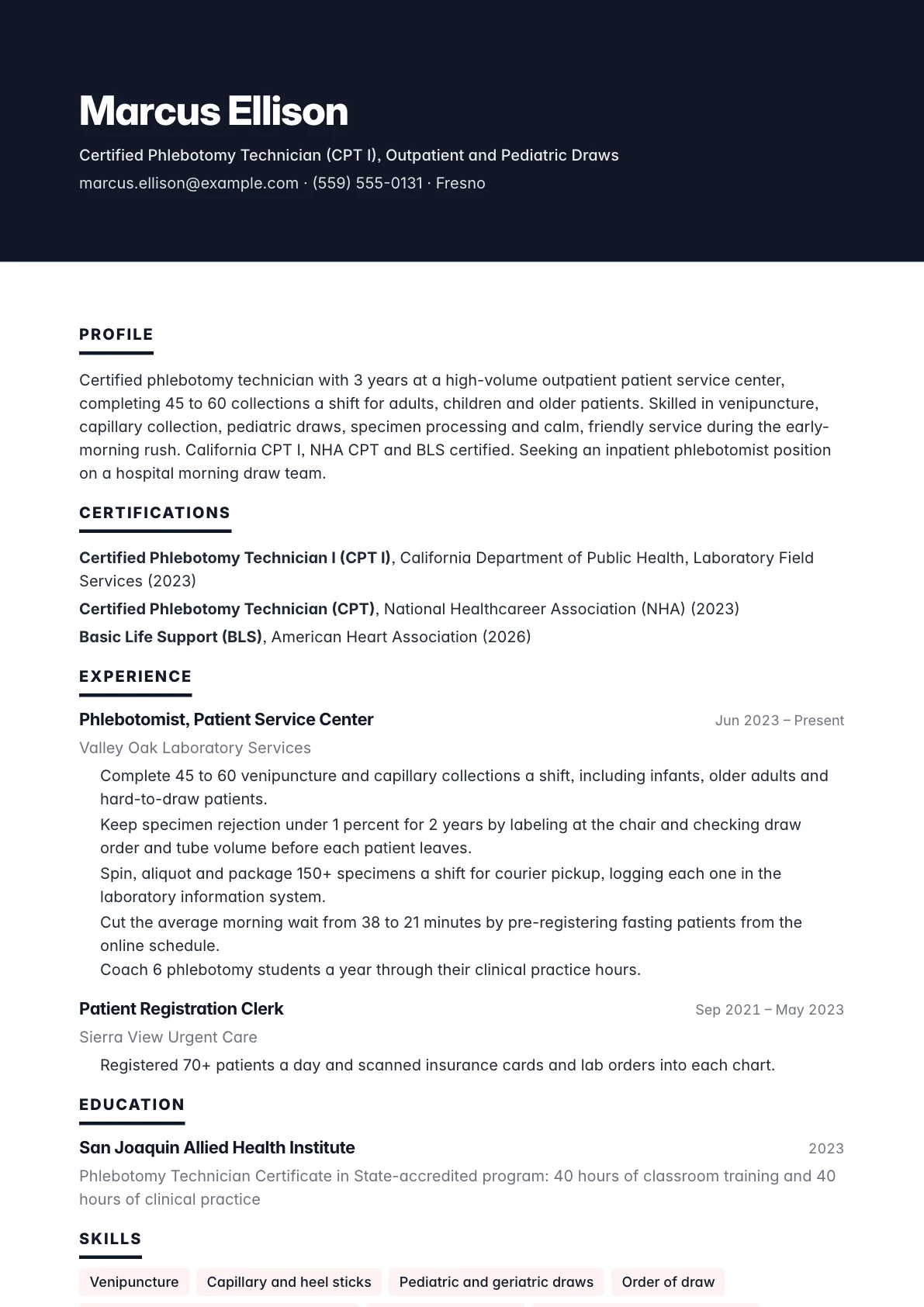
A certified phlebotomy technician with three years at an outpatient lab patient service center applying for an inpatient phlebotomist job on a hospital's early-morning draw team.

Why this resume works

  • His California CPT I certificate is listed first with the state agency that issues it, since that certificate is what authorizes his blood collection work in the state, followed by his national NHA certification.
  • Quality is shown with a lab's own measure: specimen rejection under 1 percent for 2 years, next to a pace of 45 to 60 collections a shift.
  • Infants, older adults and hard-to-draw patients are named in the first bullet, because hospital morning rounds are full of exactly those patients.
Edit & download this resume

Edit it in the free builder, then download the PDF with no watermark. A free account is only needed to download.

A phlebotomy supervisor reading your resume is asking three things. Are you certified, and licensed if the state requires it? How many draws do you do in a shift, and on whom: healthy adults at a patient service center, frail older patients on hospital rounds, babies, blood donors? And do your specimens reach the lab right the first time? Everything else, from customer service to courier logs, matters less than those answers.

This guide gives you a full example for an outpatient phlebotomist moving to a hospital, six steps for writing your own, summaries for new, experienced and lead phlebotomists, bullet examples, the skills labs search for, and the national certifications and state licenses, with links to the bodies that issue them. If you draw blood as one part of a clinic job, the medical assistant resume example may fit better.

Phlebotomist pay and job outlook

Official figures for Phlebotomists.

Median pay (2025)
$45,230 per year ($21.75 per hour)
Jobs in 2025
143,900
Job outlook, 2025 to 2035
7%, much faster than average
Change in jobs, 2025 to 2035
+9,800
Typical entry-level education
Postsecondary nondegree award

Sources: U.S. Bureau of Labor Statistics, Occupational Outlook Handbook: Phlebotomists, checked September 2026; O*NET OnLine: Phlebotomists, checked September 2026.

How to write a phlebotomist resume

1

Headline your certification and the patients you draw

Under your name, write your credential and setting, such as Certified Phlebotomy Technician, Hospital Inpatient or Phlebotomist, Pediatric and Outpatient. Draw sites differ a lot, and the headline tells the supervisor you already know theirs.

2

List state licenses first, then national certifications

If your state issues its own phlebotomy credential, list it first with the agency's name, because it decides whether you can work there at all. Then the national certification (NHA, ASCP, AMT or another) and BLS, each with the issuer and year.

3

Write a summary with draws per shift

Years of experience and the setting, the number of collections you do in a shift, the patients you are good with (children, older adults, difficult veins), your credentials and the job you want. Three or four sentences are plenty.

4

Prove speed and quality in your bullets

Draws per shift, first-stick success, specimen rejection or recollection rates, wait times, specimens processed and students trained are all numbers a lab tracks. Use them, and start each bullet with an action like collect, process, label or train.

5

Name special collections and equipment

Blood cultures, timed draws, glucose tolerance tests, heel sticks, therapeutic phlebotomy, drug screen collection with chain of custody, and the lab information system you use. Each one you can do is a reason to call you.

6

Add your training program and keep it to one page

Give your phlebotomy program with the school, year and hours, and your clinical practice site if you are new. Keep earlier customer service or healthcare jobs in one line each, and fit everything on one page.

Skills and keywords for a phlebotomist resume

These skills appear in most phlebotomy postings for labs, hospitals and blood centers. List the ones you use, and show a few in your bullets with numbers.

Hard skills

  • Venipuncture with vacuum tubes, syringes and butterfly needles
  • Capillary, finger and heel sticks
  • Correct order of draw and tube handling
  • Two-identifier patient identification
  • Blood cultures and timed draws
  • Glucose tolerance testing
  • Specimen processing, centrifuging and aliquoting
  • Chain of custody for drug screens
  • Point-of-care testing
  • Infection control and sharps safety

Soft skills

  • Putting nervous patients at ease
  • Gentle, patient approach with children
  • Accuracy under a long line
  • Clear communication with nurses and lab staff
  • Professional handling of fainting or difficult patients
  • Dependable early-morning attendance

Tools and software

  • Laboratory information systems (Sunquest, Epic Beaker, Cerner PathNet)
  • Handheld specimen labeling devices
  • Vein finders
  • Centrifuges
  • Specimen transport and temperature logs
  • Electronic health records for order lookup

Phlebotomist resume summary examples

Choose the summary closest to where you are, then change the setting, numbers and credentials to your own.

New phlebotomist

Newly certified phlebotomy technician who completed a training program with clinical practice at a hospital outpatient lab, including 100 successful venipunctures and 25 capillary sticks. Registered Phlebotomy Technician (RPT) through AMT and BLS certified. Five years in retail taught me to stay friendly with a long line. Seeking a first phlebotomy position at a lab or clinic.

Experienced phlebotomist

Hospital phlebotomist with 6 years on inpatient rounds in a 350-bed medical center, collecting 70 to 90 specimens per shift, including ICU, oncology and neonatal patients. First-stick success above 95 percent and trusted with blood cultures and timed drug levels. PBT(ASCP) certified. Seeking a lead phlebotomist role.

Lead phlebotomist or supervisor

Lead phlebotomist with 12 years in hospital and reference labs, scheduling a team of 14 across 3 shifts. Cut blood culture contamination from 3.4 to 1.6 percent with a new skin prep procedure and trained every new hire on it. Seeking a phlebotomy supervisor or laboratory operations position.

Phlebotomist resume bullet examples

Adapt these to your setting. Each one starts with an action and includes a number a lab would recognize.

  • Collect 70 to 90 inpatient specimens on 4 a.m. rounds across 6 nursing units, finishing before 7 a.m. results deadlines.
  • Draw 25+ pediatric patients a day, including heel sticks on newborns, at a children's outpatient lab.
  • Kept blood culture contamination at 1.2 percent, below the hospital's 3 percent target, for 18 months.
  • Screen and collect 30 to 40 blood donors a day at mobile drives, including hemoglobin checks and donor reactions care.
  • Performed 15 timed glucose tolerance tests a week, keeping every draw within 5 minutes of schedule.
  • Collected 20+ workplace drug screens a day under federal chain of custody procedures with no rejected forms.
  • Raised first-stick success from 88 to 96 percent after vein finder training for the team.
  • Trained 10 new phlebotomists on order of draw, labeling rules and the lab information system.
  • Processed and shipped 300+ specimens a day to a reference lab, meeting every courier cutoff for a full year.
  • Handled 12 fainting episodes in a year safely, with no patient injuries.
  • Covered 3 satellite clinic draw stations on rotation, serving about 150 patients a week.

Phlebotomy certifications and state licenses

Many employers ask for a national certification, and some states add their own credential on top. Three examples: California requires a Certified Phlebotomy Technician I (CPT I) certificate from the Department of Public Health, which for new phlebotomists means 40 hours of classroom training, 40 hours of clinical practice with at least 50 venipunctures and 10 skin punctures, a national exam from an approved certifying organization, and yearly renewal. Louisiana licenses phlebotomists through its State Board of Medical Examiners, after a national exam the board approves. Washington issues a medical assistant-phlebotomist credential through its Department of Health. Check your state, then list your credentials:

  • Certified Phlebotomy Technician (CPT) from the National Healthcareer Association: requires a training program or supervised work experience, and proof of at least 30 successful venipunctures and 10 capillary sticks.
  • Phlebotomy Technician, PBT(ASCP) from the ASCP Board of Certification: several eligibility routes, including an accredited phlebotomy program, a structured training program, clinical work experience, or nursing and other allied health education.
  • Registered Phlebotomy Technician (RPT) from American Medical Technologists: every route requires at least 50 venipunctures and 10 skin punctures.
  • State license or certificate, where required, with the state and issuing agency.
  • BLS or CPR, which many hospital and blood center postings ask for.

The example, line by line

This is Marcus's resume. He has three years at an outpatient patient service center and is applying to a hospital's early-morning draw team.

Headline: Certified Phlebotomy Technician (CPT I), Outpatient and Pediatric Draws. It gives his California credential and the patients he is strongest with.

Summary: 3 years and 45 to 60 collections a shift come first. Then his core skills, including pediatric draws, his three certifications, and the hospital morning team he wants to join.

Certifications: the CPT I from the California Department of Public Health comes first because it is the state certificate that authorizes his draws, then the NHA CPT and BLS.

Experience: the first bullet gives pace and patient range. The second is quality: rejection under 1 percent for 2 years. The third shows he processes 150+ specimens a shift, and the fourth cuts the morning wait from 38 to 21 minutes. Coaching 6 students a year shows he is trusted. His registration job stays in one line with 70+ patients a day.

Education and skills: his certificate program with 40 hours of classroom training and 40 hours of clinical practice, and eight skills in the words hospital postings use.

Phlebotomist resume mistakes to avoid

  • No draws per shift. A phlebotomist doing 20 draws a day and one doing 80 are applying for different jobs. Put your number in the summary and first bullet.
  • Leaving out the state credential. In a state that licenses phlebotomists, a missing license stops the application. List it first.
  • Writing certified without the body. NHA, ASCP and AMT credentials are all different. Write the full name and issuer.
  • Only listing venipuncture. Pediatric draws, blood cultures, timed tests and chain of custody collections are what set you apart. Name the ones you do.
  • Nothing about quality. Labs track rejected and contaminated specimens. If your numbers are good, show them.

Other healthcare resume examples that are close to this one:

Every example is in the resume examples hub, grouped by job and situation.

Build it free, no watermark

CVPoet's resume builder is free to use without an account. Start from this example or a blank page, pick one of four ATS-friendly designs, and download a PDF with no watermark on any plan.

Frequently asked questions

What should a phlebotomist put on a resume?

A headline with your credential and setting, a short summary with draws per shift, your state license if required and national certification, each job with volume and quality numbers, your training program and hours, and your skills.

Which phlebotomy certification is best for my resume?

The one your state and employer accept. NHA's CPT, ASCP's PBT and AMT's RPT are common national certifications. In states with their own license, check which national exams the state approves before you choose.

Which states require a phlebotomy license?

Rules change, so check your state health department or licensing board. California, Louisiana and Washington are examples of states with their own phlebotomy credential.

How do I write a phlebotomist resume with no experience?

Lead with your certification and training program, including the number of successful venipunctures and skin punctures from your clinical practice. Add customer service or healthcare jobs that show you are good with people.

How many draws should I say I do?

Give the honest average per shift for your current job, and a range if it varies. Supervisors use it to judge whether you can handle their pace.

What skills should a phlebotomist list?

Venipuncture, capillary sticks, order of draw, patient identification, specimen processing, special collections like blood cultures, and your lab information system. Add soft skills like calming nervous patients through your bullets.

Should I include my first-stick success rate?

Yes, if your lab tracks it and your number is good. A rate above 90 percent is a strong line. Do not guess a number you cannot back up.

How long should a phlebotomist resume be?

One page. Put your certifications and current job in the top half.

Can I list phlebotomy on a medical assistant resume?

Yes. Add the number of draws per day and any phlebotomy certification. Many clinics want medical assistants who can draw blood.

What is the difference between inpatient and outpatient phlebotomy?

Outpatient work is a steady line of mostly walk-in patients at a lab or clinic. Inpatient work means rounds on hospital units, often very early in the morning, with sicker patients, isolation rooms and timed draws.

Build your phlebotomist resume now

Start from Marcus's example or a blank page. It is free, you do not need an account, and the PDF has no watermark.

Build your resume, free
Phlebotomist resume example
Phlebotomist resume example The example above as an image, to save or share. To change it, use Edit & download this resume at the top of the page. Open the full-size image